IN WHICH WILL BE FOUND WHAT IS SET FORTH THEREIN

Tuesday, May 26, 2015

ALA Boston 2015

I was sorry to have missed the American Literature Association meeting in D.C. last year, the first I'd missed since the group's inception. But I was back in Boston with the crew this year, an exceptionally satisfactory year as things turned out.


The anthology Lauri Ramey and I edited, What I Say: Innovative Poetry by Black Writers in America, was released from the University of Alabama Press just in time for the conference, and attracted considerable attention for the poets.


This year saw the formation of an Anna Julia Cooper Society, and Mary Helen Washington, seen here with Shirley Moody Turner and Kathryn Gines, was presented the society's first award for scholarship.


There was a panel titled "Rereading Race in Gertrude Stein" which had some interesting papers, though it seems the presenters had no idea regarding the origins of their panel's title. Ah humanity . . .


This was a banner year for Mary Helen Washington. Her long anticipated study The Other Blacklist was published, and was the subject of a great panel discussion.


Among the more touching moments at the conference, the Pauline Hopkins Society presented their first essay prize for a high school student. The award was presented, along with the Morrison Society awards, at the annual reception organized by the African American Literature and Culture Society.


Evie Shockley was the recipient of this year's Stephen Henderson Award. and gave an amazing reading, introduced by Meta DuEwa Jones.


My colleagues in the African American Literature and Culture Society used the occasion of my absence last year to conspire in secrecy to embarrass me with praise. It worked. I blushed.


This year also saw the formation of the Amiri Baraka Author Society, at the instigation of Gregory Pierrot. There was a first panel, featuring wotks on Baraka and Hughes, by Tyrone Williams, Jean-Philippe Marcoux and John Lowney. There was also an inaugural round table with presentations by Houston Baker, Komosi Woodard, Aldon Nielsen, Meta Jones and Brent Edwards, chaired by Anna Everett. The organizing meeting of the society met immediately after. Pierrot is the new president,  Marcoux the Vice President. Secretary/Treasury duties being shared by the generous Anna Everett and Oty Agbajoh-Laoye. The society has already established a Face Book page, with a web site soon to follow.


Additional photos by Anna Everett and Lale Demirturk.

Saturday, May 09, 2015

E. Ethelbert Miller - The Aldon Nielsen Project #10

Q. How would you teach the poetry of Nathaniel Mackey? What does a reader need to know?


“All art is sensual . . . Listen to it! Let it come to you.”


These were the opening words of William Carlos Williams as he began a reading at Harvard University in 1951.  He was trying to get something across to his audience about the reputedly difficult modern poem, something that, even after decades of Hip Hop and Spoken Word poetry, may not be immediately apparent to some students, to some readers in the general public. The Moderns may have, following Whitman, supplemented the traditional lyric forms with a host of experiments running from vers libre to the concrete, but the music had never been left behind.  Williams himself composed poetry both for its appearance on the page and for its aural modalities. That well wrought wheel barrow, for instance, sounded different in his performance of the piece than you might have expected looking at it on the page. He’d spent uncounted hours rearranging the words on the paper till he hit upon the particular syllabic count and arrangement we all know, but he would read the poem out aloud as if there were no line breaks in the thing at all. The poem had multiple manifestations, but in each the emphasis was upon its materiality. If a poem is a machine made of words, as he had it, it’s a noise machine. If anything, the creators of supposedly free verse forms were yet more intent upon the forming of the poem as a material, shaped,  aural thing.  

And that is how we need to bring our students to the poem. Ethelbert Miller will recall a song everybody in our generation sang along with on the radio, a record by Otis Redding, one that went by the title “Fa Fa Fa Fa Fa.” [This interest in sheer sound was nothing new to Otis. Back in 1961 he released "Shout Bamalama."] The record company felt obliged, like the editors of Norton Editions, to append some clarifying note, so the label included the subtitle “(sad song),” though the song wasn’t especially sad sounding. The first two lines of the song go:

Fa Fa Fa Fa Fa Fa Fa Fa Fa
Fa Fa Fa Fa Fa Fa Fa Fa

Yes, the meter demands one less “Fa” in the second line; that’s crucial.


"FA FA FA FA FA FA FA FA FA" Live in Europe

This was so well known at the time that in the song “Do You Like Good Music,” during which Arthur Conley paid tribute to each soul music great of the era in turn, when it comes time to represent Otis, Conley sings “Fa Fa Fa Fa Fa Fa Fa Fa Fa,” the first line of Redding’s tune. 

Do You Like Good Music?

Conley’s song gets a name check in a poem by C.S. Giscombe, in “Afro-Prairie”:

Tempting for the voice to locate its noise,  to speak of or from. Everybody wants to be the singer but here’s the continent.

Fielding the question, Do you like good music?


And you’d be right to hear in there an allusion to the ideal of “field composition,” something painters shared with poets in the years of Giscombe’s childhood, and mine. (What was it about 1950?!?!)

Giscombe’s “Afro-Prairie” is prose poetry, but it calls to us for a hearing. Listen to it. Where countless writing teachers have counseled their students to “find” their voices, in Giscombe’s prose poem it is the voice itself looking for a location, a noise, from which to speak.

There are actual English words in the Otis Redding song. Turns out it’s not a sad song; it’s a song about somebody who’s been singing sad songs (think “Mr. Pitiful” - think “Pain in My Heart”): “I keep singing them sad, sad songs, y'all / Sad songs is all I know.” But the chorus, the whole lift of the piece, makes clear that the singer knows a great deal more.  And after each singing of the “Fa Fa Fa Fa Fa Fa Fa Fa Fa,” he says, “Your turn!” and the horns riff on the line. At one point in the chourses, Redding sings “our turn,” and all of us sang along.  


A student, or anybody else, picking up the most recent book of poetry by Nathaniel Mackey will have just this sort of encounter with sound prior to any reading of the book. The title staring out at us from the cover is “Blue Fasa,” and it will be a rare reader indeed (or a Ghanaian) who will already know that  the Fasa are an ancient clan in Ghana.  Open the volume and you encounter more printed sound, the words “Hoooh! Fasa!” attributed to “The Dausi,” followed by a couple bars of music written by Kenny Dorham and titled “Blue Bossa,” music alluding to the Bossa Nova craze that swept the U.S. in the same years as Otis Redding’s triumphs. Your average freshman will not know of the Dausi Epic, and probably can’t read music, and may not know what instrument Kenny Dorham played. These are the sorts of things teachers can help with, and helpful folk at New Directions Press have obliged us with initial explanations on the book’s back cover. (I may have been to Ghana, but I had not read Frobenius for some thirty years, had forgotten the Fasa,) We first see the syllables in black print against blue and white background on the cover, then feel the sounds in our mouths. “Fasa Fasa Fasa.” Only after do we turn the book over, or read the intro, and find ourselves plunged into the history and imagining at work in the poetry.


Poets of Mackey’s generation would have encountered Amiri Baraka’s foundational essay “How You Sound” around the same time they began to encounter the new jazz. Baraka’s essay, published in 1959, opens:

“HOW YOU SOUND??” is what we recent fellows are up to. How we sound; our peculiar grasp on, say: a. Melican speech b. Poetries of the world, c. Our selves (which is attitudes, logics, theories, jumbles of our lives, & all that), d. And the final . . . The Totality Of Mind: Spiritual . . . God?? (or you name it): Social (zeitgeist): or Hedieggerian umwelt.

This paragraph was my introduction to the name of the problematic Heidegger. There was no teacher nearby elucidating things. I was rapidly coming to understand that poetry was as much a place where I learned about things as a thing to be learned about.  

"There cannot be anything I must fit the poem into. Everything must be made to fit into the poem. There must not be any preconceived notion or design for what the poem ought to be."

Baraka closes by giving voice to a desire to go into a quantitative verse, but he’s thinking of a different count – His is the variable foot of Williams, the projective verse of Olson, the almost infinitely unspooling, unsprung rhythms of Tolson.  Most of our students do come to class with preconceived notions of what the poem ought to be. They got those notions from earlier classes, maybe even creative writing classes, and from Hip Hop and Spoken Word. (Why nearly everybody taking to the open mic makes the same hand gestures and assumes the same postures and takes on the same vocal approach, no matter what the words.  Why so many adopt that “poetry voice” that so many poets despise. Makes you want to holler – ask, BUT HOW YOU SOUND???)

People used to ask how to ease into something like Archie Shepp’s Fire Music: Listen to it! 

There is something to count there, but hunting is not those heads on the wall, as another Baraka essay reminds us.

As a teacher, I can tell my students about the Dausi Epic, about “Gassire’s Lute,” about how these ancient African verses were poured into the ear of Leo Frobenius, to be read and rewritten by Pound, by Tolson, by Robert Duncan, by Mackey. That’s what I can readily help students with. Anthology footnotes won’t be the most important thing when they are reading:

As with the old time people, the
word their new rescue, words
would be our rescue we’d been
told. Believing so braced us,
book
of the book’s advantage, book of
the word’s leverage . . .

When I was called upon to introduce a reading by Nathaniel Mackey recently, I speculated that there is probably some poetic juvenilia filed away in the recesses of his papers, but observed that he seems a poet who struck upon his characteristic modes of composition very early on, and those modes are largely phrasal. This is an unremarked something he shares with the elder poet who selected his manuscript Eroding Witness for the National Poetry Series, thus bringing Mackey’s first full book into public view. Michael S. Harper and Nathaniel Mackey are two really different artists, but they share this. They bring their finely attuned listening skills over from their listening to jazz into their writing of poems.  It’s not that any lines in Blue Fasa sound very much like Kenny Dorham lines, but Mackey places one phrase next to another for delight, substance playing off sound as in all truly great poetry.

As for that substance, here’s a thing I’d press on students. Mackey’s poetry is, as anyone who’s ever read any of it knows, rich in allusion, so there is PLENTY PLENTY for writers of research papers and advanced scholars to look up, and the looking up has proceeded apace. But again, HUNTING IS NOT THOSE HEADS ON THE WALL. You will want to know about the Andoumboulou. You will want to know both about ancient Mu and about Don Cherry’s Mu. You’ll want to know about Don Cherry. And any number of us have been on the track, making notes for you all along. What scholarship has been slower to get to is a broader background, a context out of which the thought in the poems arises, out of which so many poets of Mackey’s generation spun their philosophies. Early poems by Mackey cite Ivan van Sertima. Others carry quotations from John S. Mbiti. (Did it help that we read these in my classes at Federal City College before I knew there was a Nathaniel Mackey? You bet.)  Ask Mackey about these things and he’ll add people like Jahnheinz Jahn to the mix. And none of us is under any illusions about these sources. We all read Wole Soyinka’s critiques of the suppositions behind some of Jahn’s theorizing about Neo-African cultures. We’ve spotted some of the holes in the historiography of Cheikh Anta Diop and Chancellor Williams.  But these are the things that made up the intellectual equipment of so many writers who came of age during the Black Arts era. There is a reason more scholars pursue Mackey’s invocations of Duncan and Olson and Pound and not so much van Sertima and Mbiti, and it’s a not very attractive reason. So clearly one thing we can help our students with is pointing them to things that the large body of scholarship has not yet bestirred itself to look at.

But first and foremost we should introduce them to “Sprung polity’s pneumatic jukebox,” introduce them to ragas and the Rail Band, play a little Kenny Dorham for them.  We learned from our radios before we learned from life that “love don’t love nobody.” We were fools to learn, fools for learning. Get to this: “I was love’s own distant / lover.”  Play our students a bit of Marvin Gaye singing “Distant Lover.” They’ll get it. Play them some Bossa Nova, some Bassa Bassa Sounds, and they’ll come to get Blue Fasa.

Saturday, May 02, 2015

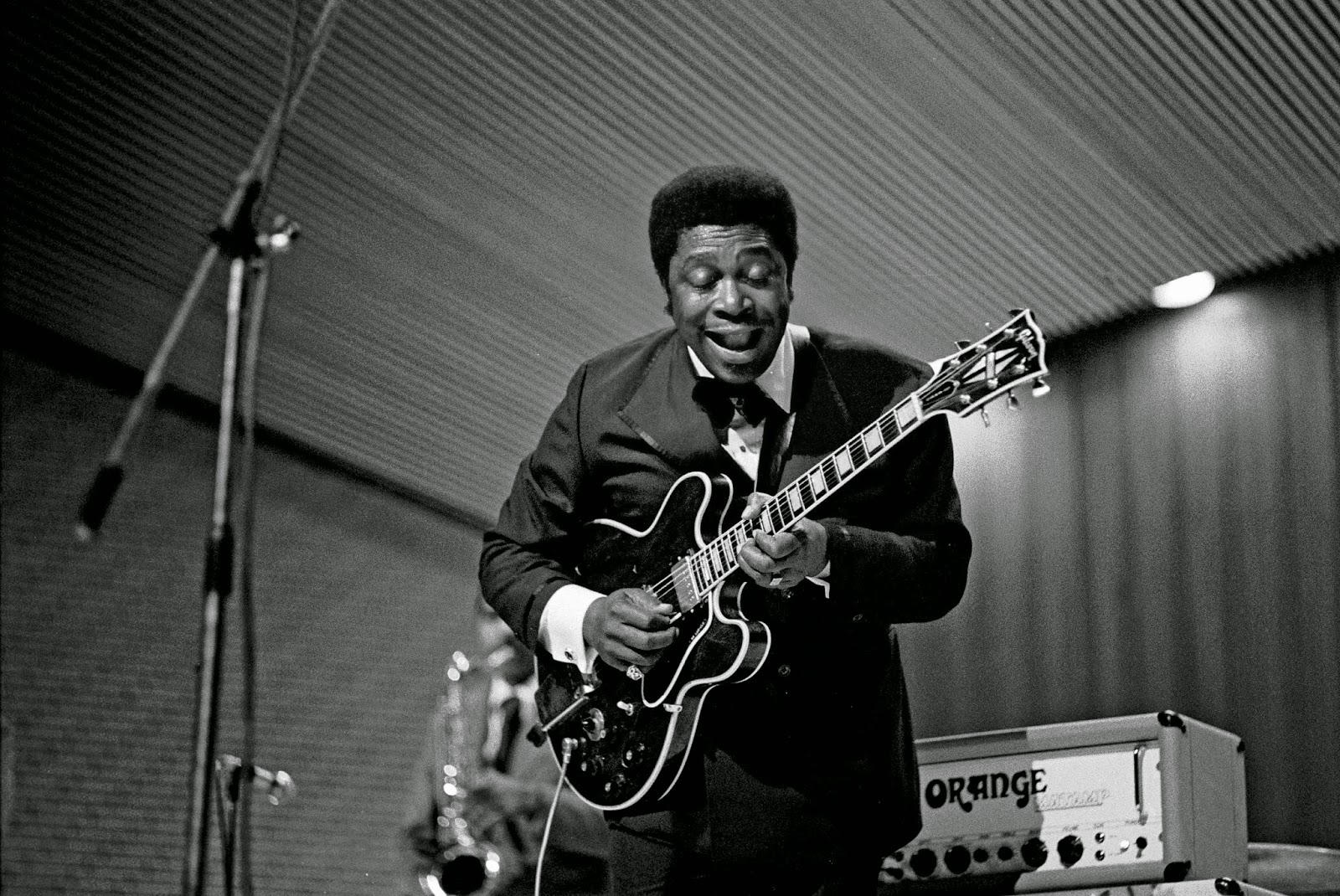
B.B. King

Been thinking a lot about Riley B. King since hearing he's in hospice -- I had hopes that somewhere on the web I'd find a photo taken of him at one of the many shows I attended -- The Cellar Door -- The Howard University Blues Festival, etc. -- But it seems none of the many people I saw taking photos at those events has uploaded anything.  In one case, that's because of a tragic photographic accident in the course of an otherwise amazing afternoon.

Here's the story.  

1969 -- The posters said that B.B. King was to open for Canned Heat at the Alexandria Roller Rink. You can't tell the program order from this ticket you see, but it was clear on the posters -- CANNED HEAT at the top of the bill -- B.B. King opening -- Rather like having Bach open for Walter (Wendy) Carlos.

Still, there was no way my friend Larry Sammons and I were going to miss this show, so we went.  Showtime arrives and nothing is happening, not a rare thing at concerts -- But more time goes by and eventually we learn that King's band has been held up by February weather on their way from the previous gig. The King himself was on hand waiting, but the band was still on the road.  Which led to this:  

1969
1969 Feb 16Canned Heat
1969 Feb 16BB King(solo)
1969 Mar 1The Jeff Beck Group

This is from the official record of shows at the Rink that season. Note the "(solo)" after King's name.  It wasn't supposed to be that way, but what a show.  As time passed, eventually a stage crew member came out and sat a little practice amp on the stage, directly in front of the massive wall of amps set up for Canned Heat.  King then walked out accompanied by Lucille. He made his apologies to the crowd (I wonder if anybody out there has a recording of this show), thanked Canned Heat for loaning him this little amp, plugged in and started to play all by himself.

This was amazing. B.B. King playing several of his most important songs solo -- Had this ever been seen anywhere?  Then, one by one the members of the band showed up, snow melting on their coats, set up behind the master and fell in with whatever he was doing at the moment.  I think the organist was the first to get there -- if memory serves he still had his coat on as he began to play. By the end of the set, B.B. King and his band were blowing like never before and the crowd was going crazy.

Through all of this, Larry was snapping away with his camera, and we were close! I couldn't wait to see what he was capturing. But then I saw him frown, hold his camera next to his ear, turning the advance lever . . . I got a really bad feeling. "I think the film has slipped off the gears," said Larry. Turned out he was right. Not a single shot to show for his efforts.

We stayed long enough into Canned Heat's set to hear part of "Shake N Boogie" and then left, working our way through a crowd that had mostly come to see the Heat.

But for one cold, February day in 1969, it was B.B. King who brought the heat.

We'll all pray for the man.

Wednesday, April 29, 2015

FLYING HOME - SEVEN STORIES OF THE SECRET CITY, BY DAVID NICHOLSON


I first met David Nicholson when we were both students at Federal City College, in courses on Criticism and in Caribbean Literature. David was also one of the editors of the school's literary mag, Slave Speaks, where we both published some of our first writings.

Now, I'm happy to report, here is David's first book of fiction, to be released next month by Rick Peabody's Paycock Press.

After graduating from FCC, by then rechristened the University of the District of Columbia, David went on to earn an MFA at Iowa. Upon his return he founded the Black Film Review and began publishing his fiction in journals. For many years he was on the editorial staff of the Washington Post Book World.

But back when we first met, he was working at a record store in NorthWest D.C., living in a nearby apartment. We were both working students (I suspect most of the FCC students were in that time), but what really brought us together was a nearly obsessive interest in literary arts and in music.

Both of those early obsessions find their way into Nicholson's fiction, and his work has been quietly recognized over the years by discerning readers. Open the leaf of this first volume and you'll find blurbs from E. Ethelbert Miller, James Alan McPherson, Henry Louis Gates, Arnold Rampersad, Sara Henry, and that's on top of the blurb from Charles Johnson that graces the back cover.

Back in my school days, Constance Green published a book with Princeton titled The Secret City: A History of Race Relations in the Nation's Capital. If you read or watch much media coverage of D.C., you'll quickly see that the life of the nation's capital is still largely a secret, often even from the people who move to the city to serve in government. But that inner life of the capital is a secret to them because they will it to be so. 

Nicholson's book gives us the lives that enliven that unrepresented space. That said, this is not reportage. These stories are wonderfully imagined projections out of the daily; like Miles, David has written what the day recommends.

Among my favorites, "Saving Jimi Hendrix," which appeared in an earlier Paycock Press collection, Kiss the Sky. Among all the other things this story does, it returns us to the author's "lost city" where he is "always 16," an alternate universe informing our own.

You can preorder this wonderful book by clicking here.


Friday, April 24, 2015

RACHEL LODEN'S KULCHUR GIRL


"Wittman had been there at Berkeley when Charles Olson read--and drew, spreading wide his arms, a map of the universe on the chalkboard--circles and great cosmic rings. And Lew Welch dangling his legs off the corner of the platform and nodding in rhythm . . . "
--Tripmaster Monkey, Maxine Hong Kingston


Kingston, Wittman Ah Sing's creator, had been there too, and so, it turns out, had Rachel Loden.


I love the cover of Loden's book. Back in the day, you got those punch cards to register for university courses. The cards in use at Berkeley at the time of the Berkeley Poetry Conference still had an attendance record running along the top.  You needed a ticket to attend the Poetry Conference events, and you registered for the thing as you would for a regular university course. This card, dated July 16, 1965, gives Loden's Westport, Connecticut, address and shows that she paid $45 for the two seminars and the readings she was able to attend. The conference was run through the university's extension program, and the then seventeen year old Loden had earned the fees by babysitting.


"LeRoi Jones was supposed to be here but he may not come. / Headline on the Realist: / 'You Don't Have to be Jewish to Love LeRoi Jones.'"

That Paul Krassner had one wicked sense of humor, AND read poetry. People who never saw The Realist would probably think of something like The Onion if you tried to describe it to them. 

"This conference heartens and alarms me," Loden writes in one of the two notebooks she had with her; a page from one of them is reproduced in this book.  

There is so much going on here. An entry marked "Olson #5" starts out with a simple citation: "Harlem Gallery. Twayne. Tolson." How much longer would it take mainstream American literary criticism to make that connection? 

Later: "Leroy McLucas & Dorn - a book - " The reference is to The Shoshoneans, a book of text and photographs that grew out of a road trip the poet and photographer made together.

On the same page: "The poets were always real to me but now I've seen them. Strangely there are no further realities after that first one of knowing and believing the poems themselves."

In the section on Olson's reading we suddenly get: "A voiceless Ezra Pound watches LeRoi Jones Dutchman & Jennifer West -- "

In the end, it comes to Bob Dylan, as all things must -- but hey, it was 1965:

"WMCA turns people on" says the ad.
Help! The Beatles.
You said you'd never compromise
With the mystery tramp, but now you realize
Talking 1965.
You're in the free world -- now you've got to stay here.

Loden's notebooks give us a window on a crucial moment in the history of American culture that can only be matched by watching film of the event itself. And even watching the film you would miss so much. You wonldn't have seen Wittman Ah Sing, for example.

Kulchur was still publishing in 1965. It was a place where you might find that same energy and similar constellations of poetics. Loden learned from it, and so can we.

Order the book here!

Thursday, April 23, 2015

NATHANIEL MACKEY AT PENN STATE

As with the old time people, the
   word their one rescue, words
would be our rescue we'd been
    told. Believing so braced us,
                                                   book
of the book's advantage, book of
    the word's leverage, lift . . .


Nathaniel Mackey was up from Duke to visit us April 12-15. Things started off with a public interview as part of our Comparative Literature Monday series. Jonathan Eburne marshalled the time; questions flew from Laura Vrana, Abram Foley, Susan Wheeler and me. The interview was recorded for later airing on cable television and will at some point be available on the PSU Comp Lit web site. 


The following day, Mackey met with our graduate students for a seminar, then closed out the visit with a powerful reading, followed by Q&A. This was the first reading I'd heard from the forthcoming volume, Blue Fasa, which can be ordered here.


There was a when, some called it
whoa, something known as time we
were in. Something said to be next
rolled in, rolled on and away, rolled,
                                                           might
soul be something we
saw 


Tuesday, April 21, 2015

POETRY FROM THE HOUSE OF ZU - E. ETHELBERT MILLER - THE ALDON NIELSEN PROJECT 09

Q. Do you feel Ahmos Zu-Bolton's contribution to African American literature has been overlooked?


When Lorenzo Thomas was considering leaving his home in New York and moving to Houston, one of his Umbra buddies told him that if he went to Texas, he would not be known as a southern poet; he would be an unknown poet.

Blackjack told me
for the 7th time
this week –

bout being in the lost
& found cell

–Ahmos Zu-Bolton II

I’m pretty sure I first saw the name “Ahmos Zu-Bolton II,” pretty sure because it’s not a name you’d forget in any context, because it’s a name that makes you wonder who the first Ahmos Zu-Bolton may have been, when I was in a D.C. book shop and picked up a copy of Synergy D.C. Anthology. – Picked it up because it was D.C., because I liked the rhyme in the title, because the all black cover had a circle cut in it through which the title was revealed from what bibliographers call the half- title page beneath. On the full title page, Zu-Bolton’s name appeared as co-editor of the volume with E. Ethelbert Miller.. I was not that long back from my draft duties in upstate New York, had missed out on much of the early seventies poetry communities of D.C. (Though I got to know pretty much everybody in those communities in the coming years.) Here was a book promising, well . . . , synergy. I bought it.

There were some names in the contents I haven’t seen in later years: Shirley Jones, Hamisi, Ebara (poets were way ahead of pop music in doing the one name thing), Anyeaum, Elgeria Farmer, Susan Thomas . . . There were some names I already knew from my reading: Sterling Brown, May Miller, Gaston Neal (who I’d seen in a TV news segment about the New School for Afro American Thought when I was a teenager, then saw in the landmark anthology Black Fire), Dolores Kendrick, Jodi Braxton.  And there were names of poets I was soon to meet: Adesanya Alakoye (who appeared and as quickly disappeared from Algebra class at FCC), Winston Napier, Joanne Jimason, and the editors themselves. Napier was to become a friend in the next decade when I was teaching at Howard and he was a graduate philosophy student. Winston used to drop by the office to argue fine points of Heidegger and Locke with me, so it was no surprise when he later edited a major anthology of black theory and criticism.  Joanne became a very good friend, but then she went to California, and when I went to California she had gone back East.

I encountered Zu-Bolton’s name again when he appeared as editor of the mag Hoo Doo. Number 1 came out in 1972, but I didn’t see it till later. I noticed that it was a project of energy blacksouth press, also the publisher of the Synergy collection, and reckoned the press must be Zu-Bolton’s projection.  Here again I encountered names I knew: May Miller, Pinkie Gordon Lane, Dudley Randall, Ron Welburn, Kalamu ya Salaam. This may well have been the first time I saw the name of Jerry Ward, here represented by two poems: “Heavy Feelings” (“I will not windex realities”) and “Generation Gap.” Soon enough I would come to know Ward’s critical work, which would continue to be important to me and to so many others. Whoever this Zu-Bolton was, he was assembling a significant roster of contributors.  Here, too, I saw again the name of Lorenzo Thomas, signed to the poem “Sounds of Joy,” emblematic of what was to be one of the most important friendships of my life.

I kept an eye out for further issues of Hoo Doo and for its editor. I believe I have the full run of the mag. That first issue included a couple poems by Zu-Bolton that were to reappear in his books, “From the Diary of Livewire Davis” (we were all still writing those personae poems with third person characters we’d thought up, though none of ours tended to the Prufrockian any more), and a piece titled “Spirit Chant” that Zu-Bolton had co-authored with Russell Chew. Like early issues of Rick Peabody’s Gargoyle, each Hoo Doo had a different look to it, though not, as Gargoyle sometimes did, a different shape. Hoo Doo II/III was not only a double issue, but a double issue published in the format of those old sci fi double paperbacks, where you’d read one novel through, then flip the book over and read the second novel from back to middle. When you got to the contributors notes page of Hoo Doo II if you turned the page you found yourself looking at the contributors notes for Hoo Doo III upside down. By issue III, the mag included poets such as Alvin Aubert, Sarah Webster Fabio, Michael S. Harper, Audre Lorde, Eugene Redmond, Alice Walker and the breath-taking Jay Wright. Zu-Bolton kept up that level of quality through the run of the journal. Number 5 was a special woman’s issue guest edited by Lucille Clifton, Amma Khalil (what became of her? In Ethelbert’s book Fathering Words you can read an amusing anecdote of the day they both got rejection letters from Hoo Doo - this was before either had met Zu-Bolton), and Audre Lorde. This began a short string of guest edited issues. The next one is (I love this) Hoo Doo 6 ½, edited by Lorenzo Thomas and Adesanya Alakoye. That issue has early Harryette Mullen poems and an essay on Baraka by Lorenzo that I don’t think has ever been republished.  Hoo Doo 7 was ably edited by June Jordan, Stephen Henderson and Ethelbert Miller. Apparently by then Ethelbert, Amma and Stephen Henderson had figured out what a Hoo Doo poem was (the question that had stumped them earlier), and now they were the ones deciding what work was genuinely Hoo Doo. That issue, dated 1980, teases readers on the last page with the promise of a Hoo Doo 8, to be guest edited by Julius Thompson and Jerry Ward, themed around Blues & Dues. Despite the impressive list of poets to be included in the planned number 8, it never happened, and more’s the pity.  Still, Hoo Doo’d had a good run, better than most, and left a legacy that scholars need to tend to.


I finally met up with Zu-Bolton when he came back to D.C. from wherever for a reading with Alakoye. Did Zu-Bolton arrive late in a cab, or do I just remember that because he read his “Taxicab Blues” that evening? The reading was in the upstairs space at D.C. Space; same space was the place I’d seen the Sun Ra Arkestra, Amiri Baraka with Steve McCall, David Murray and Fred Hopkins, Don Cherry, Anthony Davis, Sam Rivers with Dave Holland – so many great sets before the fire authorities made them stop crowding audiences into that area and start having all the shows in the restaurant downstairs. The place (at 7th and E, NW) was always a friend to poetry. Ethelbert produced a weekend marathon there and I read there once with Thad Ziolkowski, now well known as a novelist and memoirist.


We could well ask this same question of so many. Why isn’t Tom Dent better known even now? Why is so little written about Julius Thompson? Looking farther back, why so little attention to May Miller Sullivan?

heading west we cross
the great Sabine:

river of cypresses/ or
rio de sabinas

my son aks me
through the morning’s lost sleep
if real desperadoes live in Texas

“we are from a land
that is trying to assassinate love”
I tell him.
–Ahmos Zu-Bolton II

Zu-Bolton was a true literary activist, sometimes seeming more intent on distributing the works of others than looking to his own “career” as a poet. Still, you’d think the mere fact of his marriage to Harryette Mullen would have attracted the notice of one or two among the many who are now writing about her work. You’d think that the work he’d done as editor and publisher might have attracted the notice of critics working on the histories of American poetry of the later part of the twentieth century. It has often been the case that editing a journal was key to a poet’s appearing in other people’s journals and garnering a reputation. Zu-Bolton was tremendously helpful to many poets of the seventies and eighties in particular, and many openly acknowledge that help. Still, for most of that time his own work was only seen in the small press mags, and few have seen that 1975 chapbook from Solo Press.

ollie street is 2 blocks long
with a dead-end both ways.
our nation. where
home was.

Or

They told me that California
was upnorth, and Chicago
somewhere in Canada.


Zu-Bolton was clearly on his way to something, though that something was clearly not fame, or even the slight recognition of critical mention. It always struck me that he had sensed that long ago. That 1975 chapbook closes with a poem much in the spirit of Baraka’s Preface to a Twenty Volume Suicide Note. It’s a closing note of opening:

intro to my final book of poems


this is to say that I am
coming round the bend. the darkness
inside your flashes of light know me.
i throw you curves cause i wanted to be
a pitcher. a sidearming hero
you could turn to
in the late innings     (i would 
save the game
before my wounded brother got to
the shower.

but this ain’t no playground
they told me. that & the fact
that i never mastered
the screw-
ball
is the reason i am here.