IN WHICH WILL BE FOUND WHAT IS SET FORTH THEREIN

Tuesday, July 26, 2011

LAWRENCE OF KANSAS


Just back from two weeks at the University of Kansas, where I'd been invited to teach a graduate seminar for their Summer Institute for Rethinking Literature. The subject of the seminar, and of the public lecture I delivered while there, was contemporary African American Experimental Poetry and Poetics.

Found myself working every day with an exciting and engaged group of scholars from whom I learned much in the course of our discussions.

I don't know what your idea of a summer vacation might be, but three hours a day reading and talking about poetry with this group was just what I needed to get through that heat wave that enveloped most of the country this July.


As it turned out, my time in Kansas coincided with the final stages of the Women's World Cup, so it was off to the Buffalo Wild Wings Grill to watch the championship game on their big flat screens.


At the close of the seminar, we all went to "The Pig" (don't ask) for a final and joyful goodbye.


Monday, July 18, 2011

Burning Kansas Remembers Gil Scott Heron


Saw this display in a window on Massachusetts Street in Lawrence, Kansas last night on my way to the poetry reading. It's going home with me. Thanks to the store staff.

Wednesday, July 13, 2011

In Lawrence


I'm at the University of Kansas for their Institute for Rethinking Literature. Whenever I'm about to start rethinking literature, I like to meet up with a poet for drinks first. Jim McCrary (note the San Jose State baseball cap here depicted) kindly welcomed me to the Free State Grill, where I got a John Brown Tee shirt. Jim shared his memories of David Bromige with me. Max Douglass was someone Jim had known both in California and Kansas -- If you've never heard of Max Douglass, you should first read Kenneth Irby's great poem For Max Douglass and then you should try to locate a copy of Douglass's Collected Poems.

From Jim's own poetry, here's a passage out of Dive, She Said:

Some too will agree
it doesn't go
towards our finish
when that might be
fence and
moving fast

Ahh what's the use
we do go on
this old way

Friday, July 08, 2011

KANSAS!

I'm heading off to the University of Kansas for their Institute for Rethinking Literature.

If you happen to be passing through Lawrence, be sure to drop by --

Saturday, July 02, 2011

Ed Roberson - Winner of the 2011 Stephen Henderson Award


The Stephen Henderson Award for achievement in literature was established by the African American Literature and Culture Society in memory of one of America's most respected literary critics, the author/editor of Understanding the New Black Poetry. This year it was my honor to introduce Ed Roberson on the occasion of his receipt of the award in Boston. It was my last official act as president of the society and I could not have asked for a better way to finish my term.


Ed read passages from his most recent book, To See the Earth before the End of the World, and was greeted by an enthusiastic audience.


Friday, July 01, 2011

AMERICAN LITERATURE ASSOCIATION - BOSTON 2011


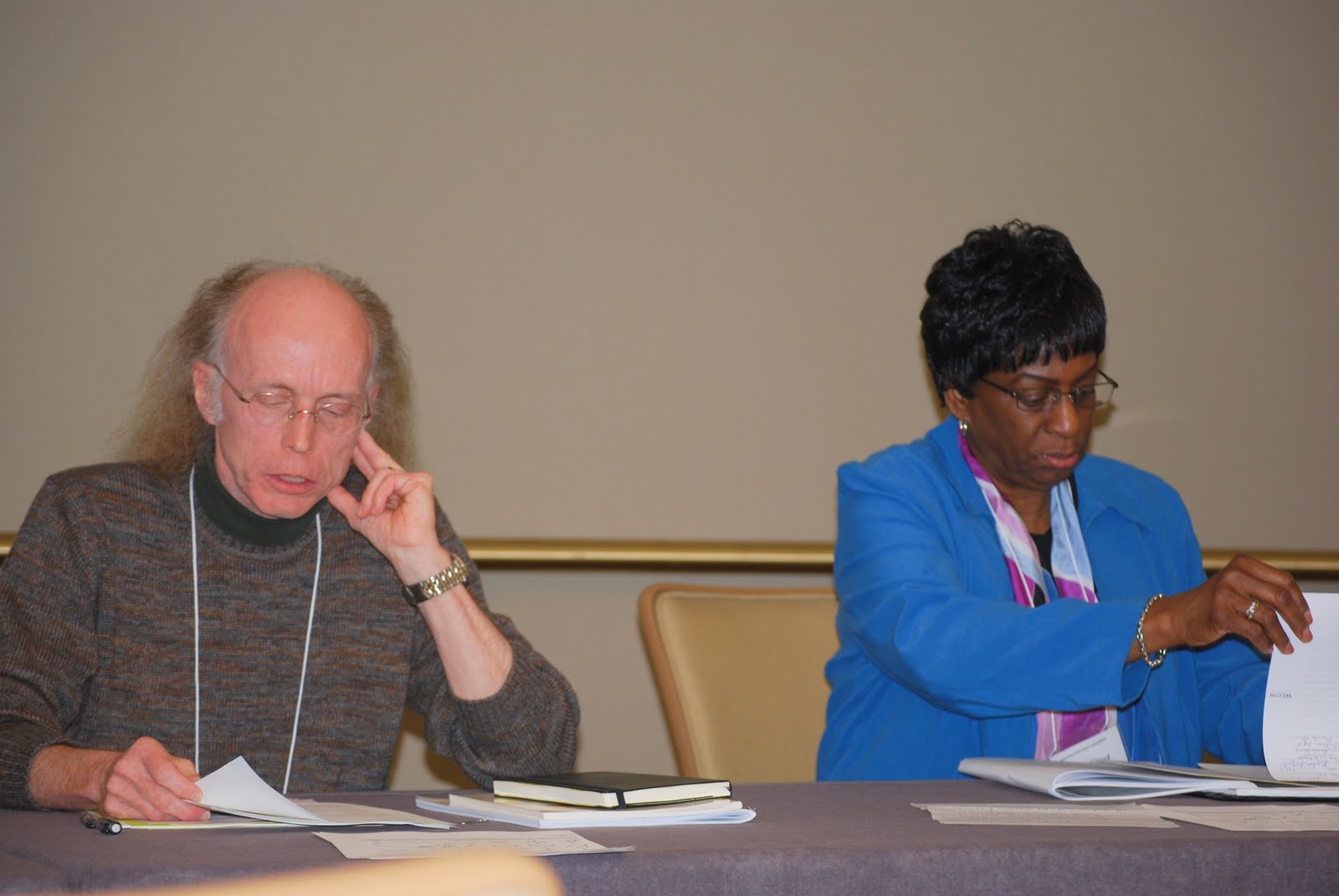
I've been in North Carolina so am a bit late in posting photos from the 2011 American Literature Association in Boston. This was my final year of service as President of the African American Literature Association. As of now, the new officers are President James Peterson of Lehigh, First Vice President Keith Byerman of Indiana State, and Second Vice President Shirley Moody Turner of Penn State.


We had an exceptional set of panels this year, including such presentations as the first critical analysis I've heard anywhere of Jerry Ward's Katrina Papers.

My friend from grad school days Richard Flynn was there, along with his son, Richard Flynn, who is commencing graduate work at Brandeis. One of Richard's Georgia Southern colleagues had her daughter with her.


I've always enjoyed seeing people bring their children with them to conferences, but now I'm starting to feel uncharacteristically grandfatherly.


and somewhat interstitial . . .

Tuesday, June 14, 2011

on WHAT WAS AFRICAN AMERICAN LITERATURE

"The dialogue that is African American literature really gets going with the slave narrative, the first book-length manuscript of which was published by Olaudah Equiano in 1789." --Chris Jaynes

Professor Jaynes, recently ejected from a tenure track position, goes on to make clear that he does not confuse the goals to which African American literature might be directed with its ontological status as a literature, and writes of it, I note, in the present tense. But then what would he know; he couldn't even hang on to a tenure track in a literature department. Worse still, he is a fictional character, an African American fictional character inhabiting the dialogue that constitutes a literature called "African American." See PYM, by Mat Johnson.

Monday, June 13, 2011

Warrenized


[The last time I was asked to write for a symposium about a book was during the Modernist Studies Association, for their meeting in Nashville. The symposium, organized by faculty and staff at Vanderbilt, was a retrospective on Robert Penn Warren's WHO SPEAKS FOR THE NEGRO. I couldn't help thinking of the coincidence when I was asked by the new on-line Los Angeles Review of Books to participate in a symposium responding to another Warren book, Kenneth Warren's What Was African American Literature. Here is the response I wrote for them, published in today's issue.]


WASNESS
Aldon Lynn Nielsen

As someone who has devoted a considerable part of his life and energies to the study of what I took to be contemporary African American literature, I suppose I may be forgiven the trepidation with which I approached a book whose central claim is that there is no such thing, especially as this book was written by someone, Professor Kenneth Warren, whose earlier work I have learned from and cited in my own. But I will concede at the outset: if we define African American Literature as something that “would not have existed as a literature” had it not been for “white suspicions of, or commitment to imposing, black inferiority,” then, yes, as Warren argues, “African American literature as a distinct entity would seem to be at an end.” I would go farther, even, and suggest that if we define African American literature as “a postemancipation phenomenon that gained its coherence as an undertaking in the social world defined by the system of Jim Crow segregation which ensued after the nation’s retreat from Reconstruction,” as Professor Warren does on the book’s first page, then African American literature may never have existed at all, for, as he notes, “the mere existence of literary texts does not necessarily indicate the presence of a literature.”

But this begs the question: why would anyone be satisfied with such a procrustean definition of the field of African American literature? Warren never really supplies sufficiently compelling (to this reader at least) answers to that question, despite his powerfully engaging readings of literary history and recent debates.

His argument feels familiar. I am old enough to have met the first person who ever received a doctorate in American Studies, and I have worked in the past with faculty who regaled me with stories of battles with their own senior colleagues, those traditionalists who weren’t sure there was such a thing as American literature. The earliest scholars to configure a collection of texts that they termed “American Literature,” of course, did so with no thought for the writings of black Americans – and thus devised just the sort of “American Literature” that supplied the motivation and coherence for configuring an African American literature. In the years of my schooling and early writing we witnessed a flood of critical works on the invention of “America,” “sexuality,” “Africa,” the “Orient,” and even “the human,” so it was inevitable that scholars who had come to think of such categories as invented, would, in turn, shift focus from their birth to their demise. And so we had the end of history and even the end of the human, and just as Warren argues that African American authors once wrote literary texts that were not “a literature,” and may now be doing so once more, we were encouraged to think that, while things might continue to happen, they would no more constitute history, and while things might continue to be written, they would no longer constitute a literature.

In a world of such fine distinctions, the assertion once made by conservative white critics can now be made by a prominent African American critic: African American literature, perhaps, is not. In a much cited passage, cited again by Warren, Henry Louis Gates, Jr., advanced the thesis that “unlike almost every other literary tradition, the Afro-American literary tradition was generated as a response to eighteenth- and nineteenth-century allegations that persons of African descent did not, and could not, create literature.” This last was certainly the position adopted by Thomas Jefferson, who, in an argument parallel to Warren’s in places, held that while Phillis Wheatley wrote poems, she did not write literature. This widely repeated passage from Gates shows us, at the very least, that Professor Gates is not a poet, and neither was Thomas Jefferson. But the importance for the present debate is this: If we choose to accept Gates’s argument, then we must also accept the implication that this “response,” and thus African American literature’s reason for being, might one day dissipate. In “The Negro Art Hokum,” first published in the Nation on June 16, 1926 (and now perhaps best known for having prompted Langston Hughes to write the much more famous “The Negro Artist and the Racial Mountain”), George Schuyler boldly holds that there was not and never had been an African American literature. Warren here reproduces Schuyler’s devastating quip to the effect that “Negro art ‘made in America’ is as nonexistent as the widely advertised profundity of Calvin Coolidge.” Negro art did not exist, in Schuyler’s view, because of the ontological status of the Negro, who, according to Schuyler, was no more than a “lampblacked Anglo-Saxon.” Where Gates holds that African American literature came to be for reasons that might one day no longer hold, and Schuyler argued that there had never been and never could be an African American literature, Amiri Baraka, in his essay “The Myth of a Negro Literature,” an essay assuredly not cited by Warren, made the provocative case that there had never been such a literature, only, as per Jefferson, black middle class imitations of white writing. In Baraka’s estimation, African American literature was not, as Warren has it, something constructed in retrospect, but something whose possibility lay in a future writing.

As provocative and mischievous as Baraka, Warren suggests that the objection that African American artists continue “to write what they understand to be African American literature,” might “have been met more easily had I given the book the titleWhat Was Negro Literature?” He is probably right about that, but had his book been so titled, it would not have so rapidly become the subject of an online forum in the influential Chronicle of Higher Education or a collection of responses in the new Los Angeles Review of Books, let alone, as is surely inevitable, the occasion of many heated panel discussions at professional conferences. But what of that “Negro literature” that apparently did not exist as Negro literature in the antebellum era? Warren’s argument makes Phillis Wheatley and Jupiter Hammon part of African American literature only retroactively, but what, then, did Jupiter Hammon think he was doing when he wrote to his fellow poet in slavery Phillis Wheatley? It will not do to say that writing by slaves was not a literature until we said it was, nor will it do to make such a case regarding the writing of free blacks in the antebellum period.

Once he’s decided on his basic distinctions, Warren is a little careless with his evidence. In reading James Weldon Johnson’s introduction to Sterling Brown’s first collection of poetry, Southern Road, Warren finds Johnson tracing a view of the earlier writing much like his own. “In Johnson’s brief comments,” as Warren characterizes them, there had earlier been “simply Negroes who were writers–or perhaps one could helpfully say that they were writers who were not yet Negro writers.” In my own scholarly practice I’ve had to learn to resist being so “helpful” to my sources. This is not what Johnson says at all, as is readily evident in the very passage from Johnson that Warren quotes, where Johnson writes:
it is only in the last ten years that America as a whole has been made consciously aware of the Negro as a literary artist… . It is only within these few years that the arbiters of American letters have begun to assay the work of these writers by the general literary standards and accord it such appraisal as it might merit.
It is one thing to acknowledge that many black American writers harbored hopes that their work would convince the larger American polity of something, and it is quite another to posit this as the primary motivation for the literature’s very existence. We should not enlist Johnson in the argument that African American literature only becomes African American literature once recognized by that “America as a whole” and those “arbiters” Johnson has in his sights. One needn’t be a black nationalist to get a bit queasy at the suggestion, and he is arguing something quite different here.

The untenability of the book’s central thesis produces a number of slippery spots in the text. Warren makes an important distinction between indexical and instrumental texts, but then reads novels as if they were social science. Schuyler’s novel Black No More, for example, is a book that, we are told, “demonstrates” that “even when race no longer matters, all sorts of inequalities can still count in American social life.” I dearly love Schuyler’s novel, one of the most deadly satires of race in America ever written, but I’m not sure that fiction can safely be held to “demonstrate” a truth of social life in quite the way Warren suggests. Warren states that “it is arguable that since The New Negro, only three or four edited collections … have had a field defining effect … comparable to Locke’s earlier volume,” and he specifies Baraka and Neal’s Black Fire, Gayle’s The Black Aesthetic and Gates’s “Race,” Writing and Difference. The first two items on this list may have had an even greater reach than Locke’s collection. They reached far beyond the academy and were part of a general figure/background shift in thinking about black arts. As important as the Gates collection is (and it is very important), it’s not at all evident why it should be privileged above such volumes as The Reconstruction of Instruction or Chant of Saints. (For that matter, Warren’s comment has the effect of disappearing such field-changing collections of African American feminist work as Mari Evans’s Black Women Writers, Sturdy Black Bridges by Bell, Parker and Guy-Sheftall, or Mary Helen Washington’s Black Eyed Susans and Midnight Birds.) More tellingly, Warren cautions readers against confusing the story of “what African American literature was, as opposed to what it is now,” and yet he has already told us, and continues to tell us, that African American literature is not. “African American literature has come to an end.”

Warren himself alerts us to the echo in his title of Leslie Fiedler’s What Was Literature?and the lectures that produced this book participate in that rhetoric of wasness: What Was the Oxford Movement?, What Was Socialism?, What Was Shakespeare?, What Was Postmodernism?, and, my own favorite, What Was the Hipster? Warren’s book has already demonstrated Fiedler’s ability to stir up conversation, but I worry, still, that little of real use will come of that discussion, which is too bad. Warren has, while tossing his grenades, given us some truly interesting readings of the evolution of African American intellectual debates over a crucial period, raising, for example, the importance of the special issue of the journal Phylon titled “The Negro in Literature: The Current Scene,” a collection that has been, as Warren details, sadly overlooked, and one that has much to tell us about the unfolding of what was, and is, for want of a better term, African American literature.


Monday, May 30, 2011

Professor Gil Scott-Heron

small talk at 125th and lenox
a collection
of black poems
by
gil scott-heron
photographs by steve wilson
THE
WORLD
PUBLISHING
COMPANY
NEW YORK
AND
CLEVELAND


The very first LP released by Gil Scott-Heron bore the legend "A NEW BLACK POET" above the title, and that's the way I want to remember him. The world first knew him by way of a recording, "The Revolution Will Not Be Televised," which has become so much a part of our vocabularies that people routinely allude to it in print without feeling the need to identify its source. The recording most remember was not, though, Scott-Heron's first version of the piece. His first album included a version that was very much what he had been doing live; the second version, found on his second album, featured a full band with a driving bass, and that's the one we all heard booming from our radios. A poem -- on the radio -- and it was a hit. Dylan had broken the restrictions on the length of a pop record (though most radio stations played a version missing one verse), and now Gil Scott-Heron had shown you could have a hit record that was in fact a poem. No singing at all -- and so we were almost surprised when we got the album and found that he sang too -- that, in fact, he was a great song writer. Before you knew it there were covers of his compositions everywhere. If you've never heard it, look up Esther Phillips's scorching version of Gil's "Home Is Where The Hatred Is." La Belle, no longer the Blue Bells, even covered "The Revolution Will Not Be Televised," mashing it up with "Something in the Air." These were the kind of recordings that could change your life.

I first knew of Gil Scott-Heron by way of those records, but I soon came to know him as a writer and a teacher. As a newly enrolled English major at the Federal City College in my home town, Washington, D.C., I was working a night shift across town and then going to school full time in one of those "temporary" buildings, this one over on E Street, left over from the second World War. (That building, which then housed most of the humanities for the college, later became a shelter for the homeless. Now it's gone, temporary at last.) There were always vendors with tables outside the building, selling African arts, tapes, incense, you name it. As I sat in Gregory Rigsby's Caribbean Literature course on hot days with the windows open, I could hear Doug and Jean Carn's vocal arrangement of Coltrane's "Acknowledgment" floating up from the vendor's boom box below.

And my Professor for Creative Writing was Gil Scott-Heron.

I'll admit to being a bit awed as I approached the first meeting of the course. This guy was just a year-and-a-half older than me and had already published two novels, a book of poetry, and four record albums. He'd just recently earned an MA in writing from Johns Hopkins University over in Baltimore. That first novel, The Vulture, was a murder mystery with an intricate plot. Clearly Scott-Heron knew something about the form. His second novel was one of the first to offer a depiction of the contemporary HBCU with its plot involving radical politics at a black college.


Came the first day of class and I entered the room to find just two people there, a young woman and a tall skinny dude wearing a World War I aviator's cap and gloves that had no fingers. I of course took a seat by the young woman and struck up a conversation. At one point I expressed the hope that there were more than three of us in the class. Without looking up, the skinny dude, who'd been furiously making notes the whole time, said, "Oh, there's fifteen people signed up." That, as it turned out, was Gil Scott-Heron.

Gil was one of the three professors most responsible for what I went on to become in my career. He rapidly saw what I was trying to do and was encouraging from the outset. We spent many hours in his office kicking around ideas about books we loved. (He always carried an attache case, and as that case sat open on the floor of his office you could see the distinctive shape of his first book of poems sticking up out of a pocket in the lid, a book tall and skinny like its author.) Like all good creative writing teachers, he assigned a lot of reading. I'd already read people like Chesnutt and Toomer on my own. My first African American Lit class had brought me to Melvin Tolson. To my reading of more "out" novelists like Ishmael Reed, Gil added the works of John Hawkes, who I had never read before. The Lime Twig was on that first syllabus. Gil read voraciously and read every type of literature. In addition to the most experimental novelists, he also had a real taste for genre fiction, especially genre fiction built around some challenging formal device, like his own first novel. I remember he loved The Taking of Pelham 1 2 3, and I can see why. (These guys take over a subway car; then what?!) Gil would diagram these plot issues with us on the blackboard and we'd discuss how to handle various intricate corners we might write ourselves into and out of. Gil also read and liked to talk about We Almost Lost Detroit, one of the first books to raise popular concern with nuclear safety issues. That reading in turn led to the creation of the song "We Almost Lost Detroit This Time," which Scott-Heron performed at the legendary No Nukes concert, and you can hear it on the album made from that benefit concert.


Sure enough, a few more students showed up, but one thing that made that first class so worthwhile was its intimacy. We all felt free to talk about anything and our work benefited from it. I was already publishing poetry by then, but Gil's class was a place where I could try out new ideas.


I took a second class, but by then word had gotten around that Scott-Heron was teaching at FCC and the class was filled to the brim. The college, which was not paying Gil much, wanted, like all colleges, to shoehorn as many students into as few classes as possible. Gil, an accomplished performer from an early age, had no trouble managing a large class, too large for creative writing, and we still had those great, free-ranging discussions in his office. (The phone by then rang constantly. Gil would answer, and was always nice to the people on the other end. But whenever they asked him about the music he'd tell them to call Brain Jackson, his partner in the band, who knew much more about music.) It was clear, though, that Gil, who had now signed with Arista records and was touring more frequently, would not much longer have the patience to deal with the college administration. Soon enough he had left the school, and teaching, behind.

Years later I had become a professor myself, at San Jose State in California. Gil Scott Heron was playing at the Great American Music Hall in San Francisco. I met him back stage and had the pleasure of presenting him with a copy of my first book of literary criticism, autographed. (For some reason, I had never thought to ask Gil to autograph any of his albums or books -- and my papers with his comments on them vanished many moves and years ago.) For a minute there, just a minute, it felt like we were back in that tiny office in that temporary building in D.C. again, just two guys with no air conditioning talking poetry for hours.

The world knows Gil Scott-Heron as the performer of those great songs, looming over his electric piano, cap on head, singing, "Now it's winter / Winter in America." But for me, he'll always be that prodigiously talented young man, a copy of his first book of poems poking up out of his attache case, excitedly telling me about some book he had just finished reading.

Wednesday, May 18, 2011

Parroting Will: On the Substance of Will Alexander's ON THE SUBSTANCE OF DISORDER

I somehow missed the Blanc Press PARROT series, which appeared in LA in the years after I'd left for central PA -- but now Insert Press is bringing them back in a sudden flock. These are gorgeous little pamphlets, designed to parrot the pamphlets once published by Black Sparrow Press. (See the black parrot on the cover?) This being PARROT Seven, there are seven black and blue parrots on the back cover. Once insert has completed the run of facsimile parrots, the entire set will be made available as a limited edition, signed and numbered set.

Number seven, seen here, is Will Alexander's On the Substance of Disorder, which you should order. Visit the Insert Press web site by clicking here.

"You see, I am simple in the sense that the lamp burns beside me and I speak." -- Will Alexander

Monday, May 09, 2011

What goes around . . .

"Thirty years ago, conceptual artists claimed to have broken with the forms of commodified art by no longer creating solid objects available for private ownership, but instead specific forms for the presentation or spatialization of ideas: a hole in a wall, a crack running through a building, [the New York Times], a line in the desert, etc. And yet intellectual and artistic property did not disappear; it simply underwent a displacement. Artists increasingly began to be viewed--and paid--as owners and sellers of ideas as such. This meant that intelligence itself came to take the place of its products, implying a radicalization in the idea of private property. The immateriality of concepts and images, instead of doing away with private appropriation, turned out to be its best refuge, the place where its reality is tantamount to its self-legitimation."

--Jacques Ranciere, Dissensus: On Politics and Aesthetics [except for the part about the NY TIMES]

Friday, April 22, 2011

Poets jam in Louisville


Navigate on over to the Heat Strings page at Penn Sound to hear a recording from this year's group poetry jam at Alan Golding's homestead in the widening wake of the Louisville Conference on Language and literature after 1900. Quite a bit after 1900, as it turned out.

Monday, April 18, 2011

A LITTLE MAN WHO WASN'T THERE


He wasn't there again today.
Oh, how I wish he'd go away.