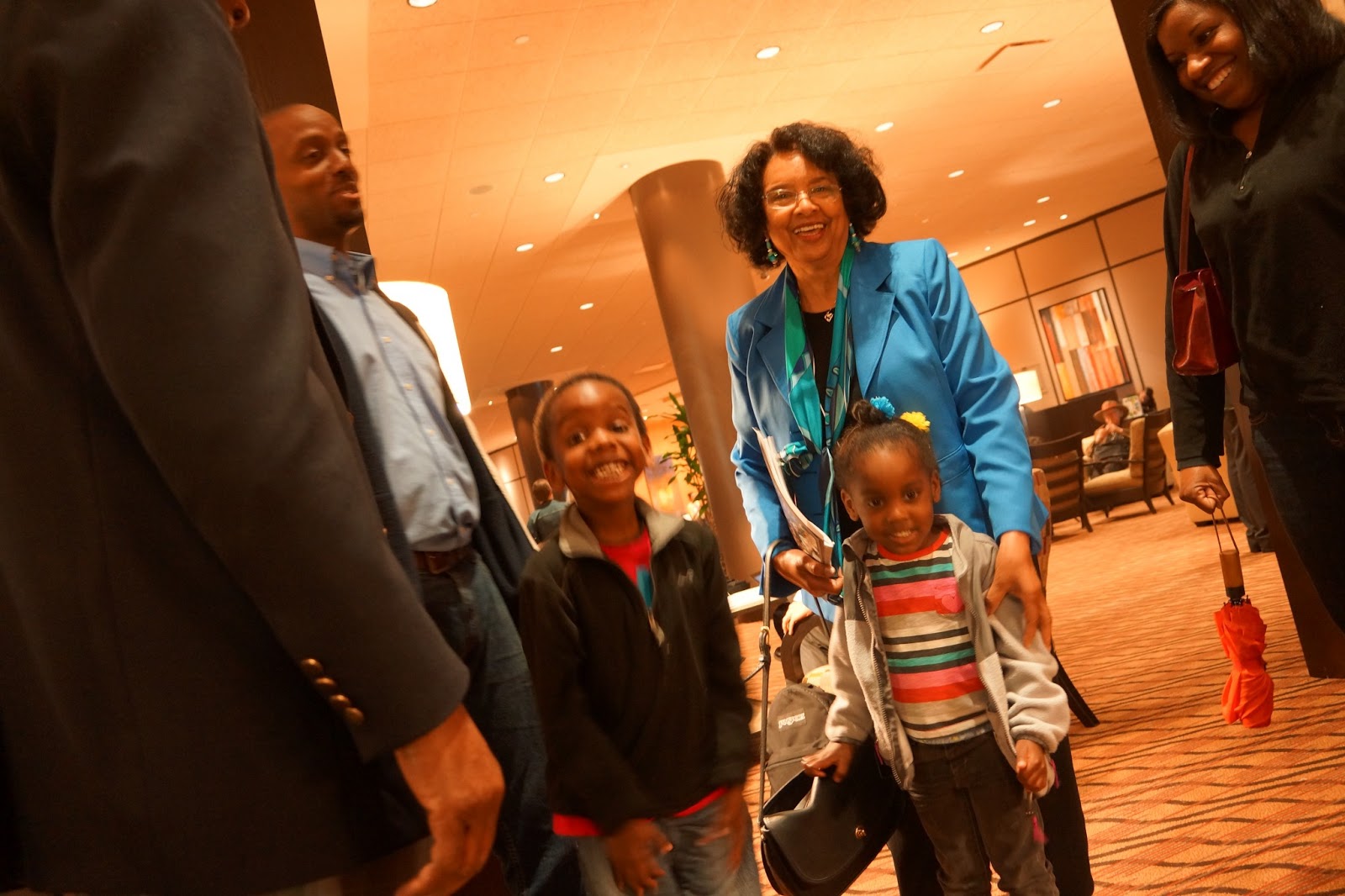
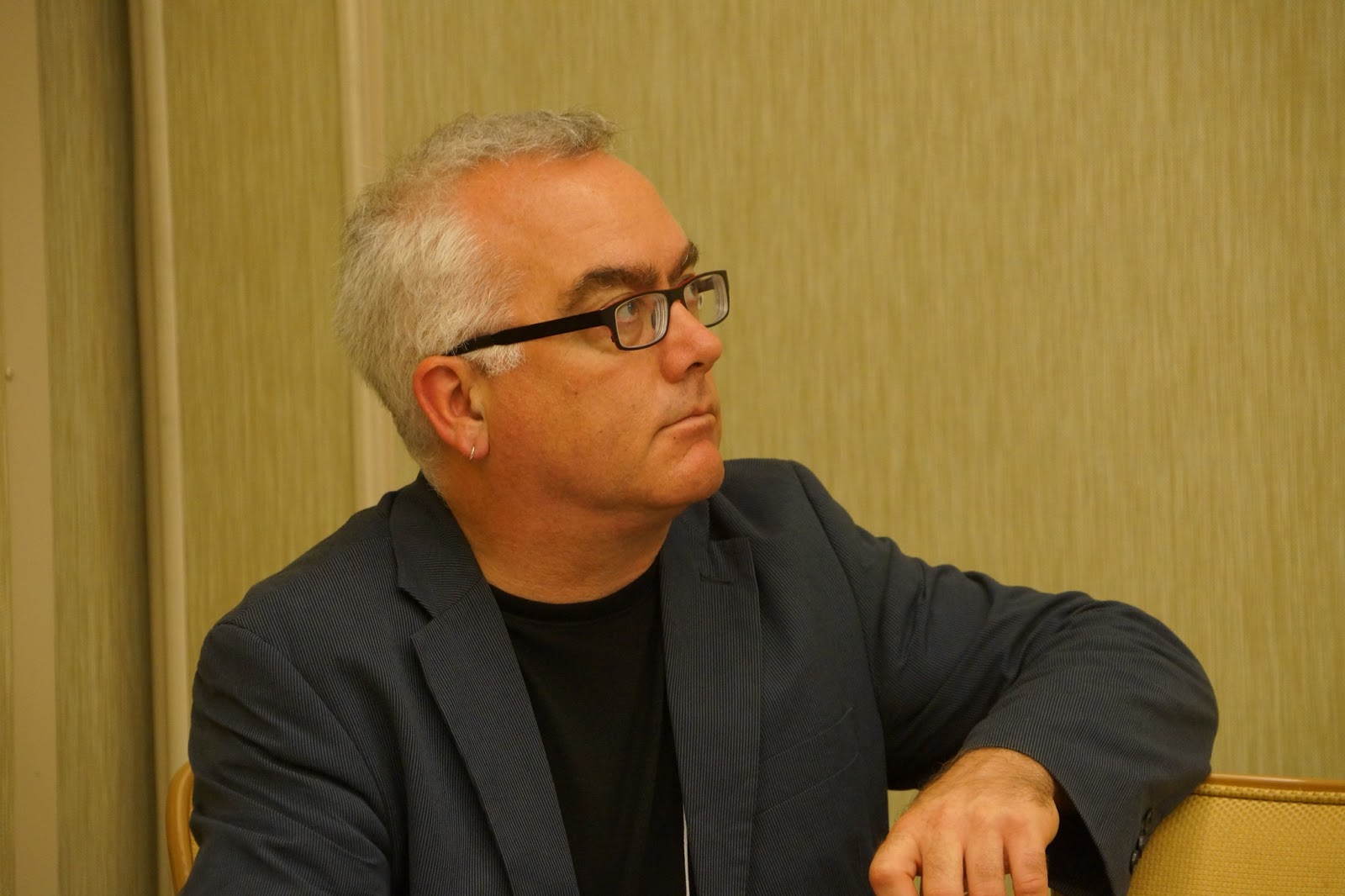
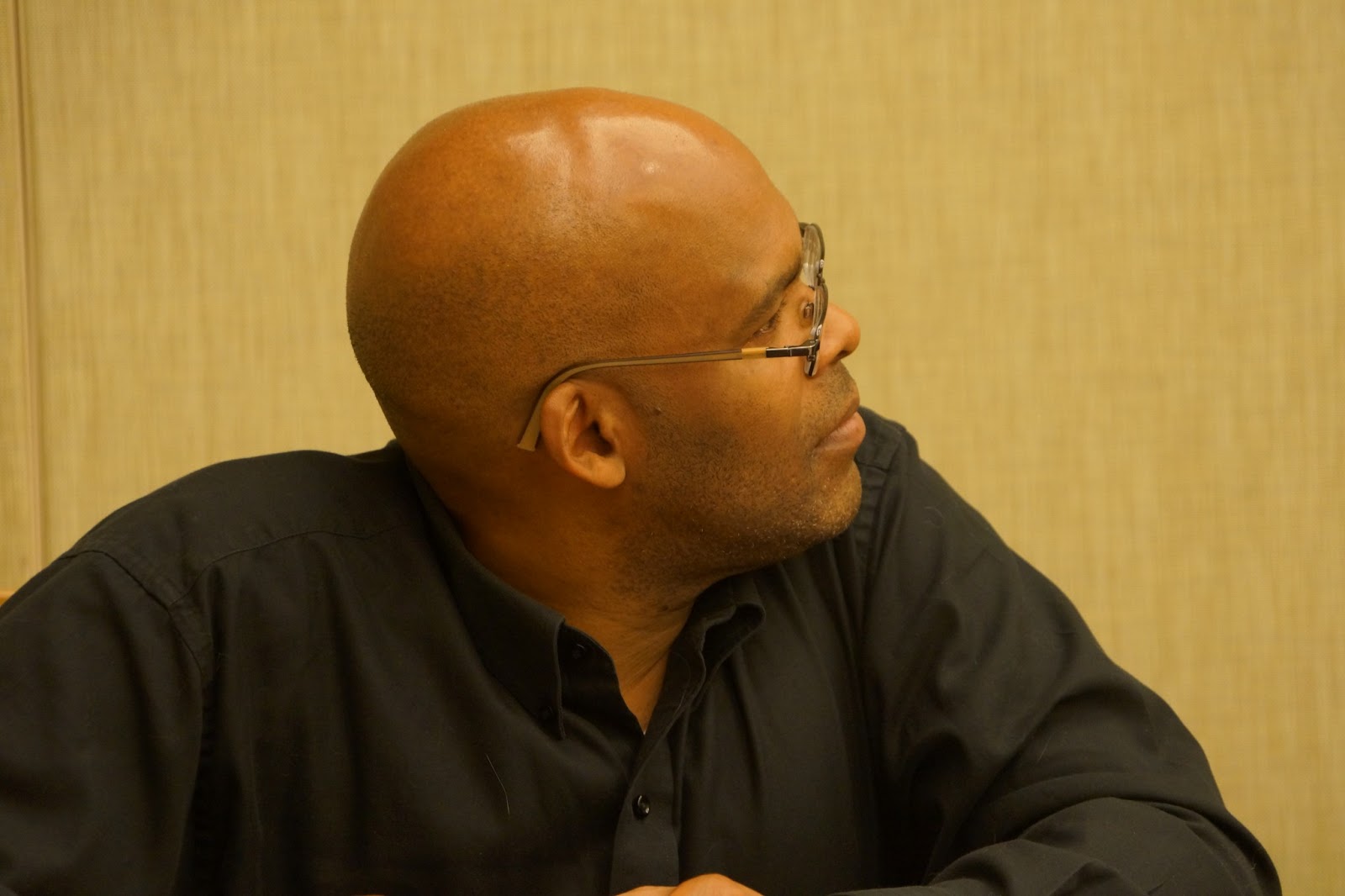
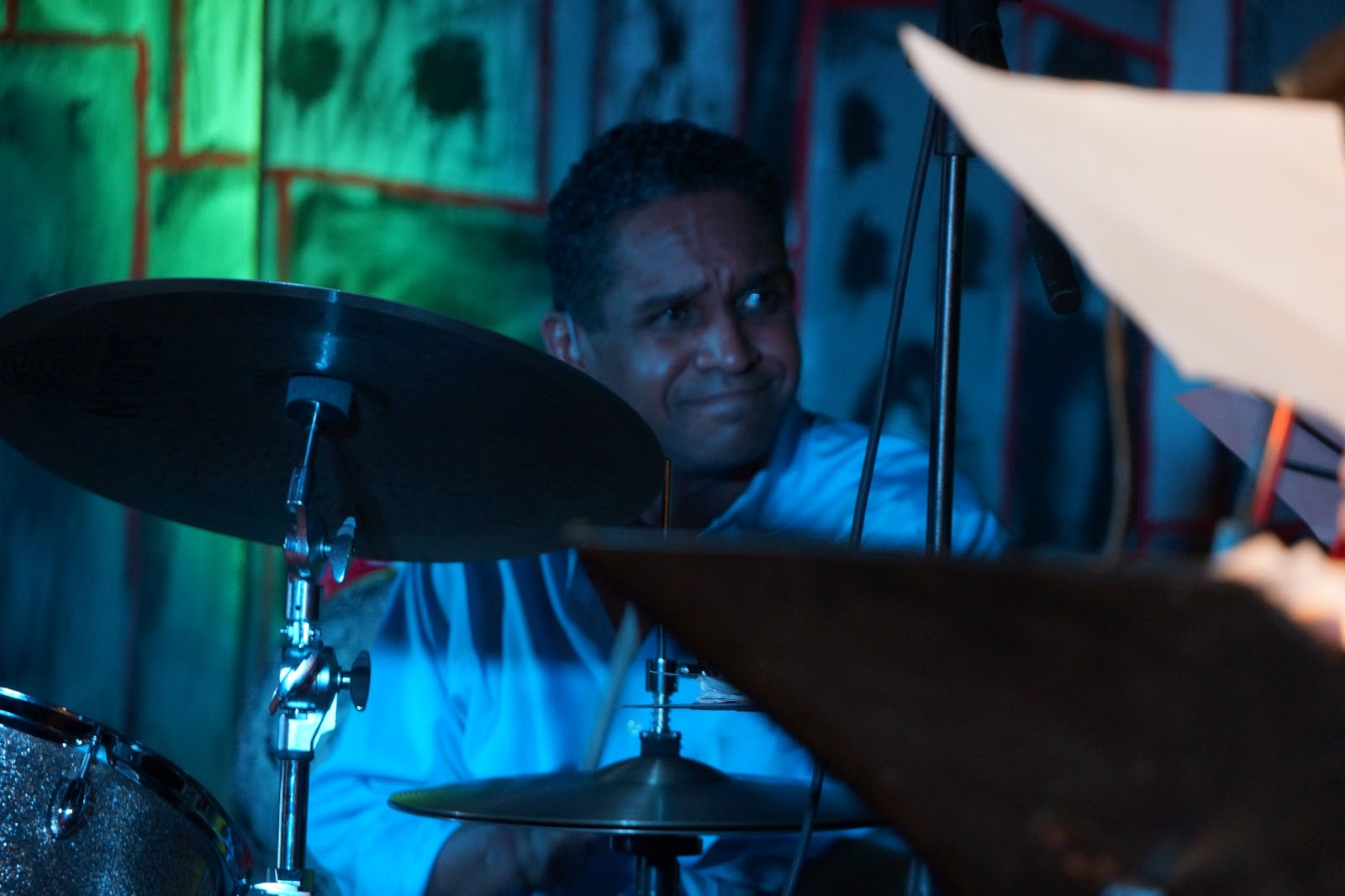
I somehow always forget that when the American Literature Association convenes in Boston every two years, we share the city with the Boston Anime Festival, which is an annual event supervised by the (I'm not kidding) New England Anime Society. I'm sure they regard our regard for poetry rather the way I regard their costumes. It's only when I encounter the space animeese in the mall that I remember we share this space.
This year the African American Literature and Culture Society was celebrating its twentieth anniversary, and I was part of a retrospective panel of former society presidents. For my part, I looked back to the very first ALA in San Diego, at which the Langston Hughes Society was the only member of the ALA coalition devoted to a black author. We've come the proverbial long way, and now nearly every time slot of the four day conference (we outlast the Anime!) presents opportunities to discuss African American literature and poetics. Among the highlights this year: an incredible paper by Margo Crawford that turned out to counter in advance a defense of Kenneth Warren's What Was African American Literature (making many of the same logical errors as Warren's book) later in the conference; AND an entire panel devoted to Ethelbert Miller's year-long E Channel experiment in which he interviewed Clarence Major every day for a year. -- Had a long lunch with Ethelbert later and got caught up on D.C. and Poet Lore. -- This year's Stephen Henderson Award went to poet Michael S. Harper. (If you haven't already, read his extended recent work Use Trouble, perhaps the most "out" work of his career; Harper has stepped up his phrasal mode still farther.) Harper wasn't able to attend, due to health issues, and Herman Beavers, originally slated just to do the introduction, gave a partially improvised talk/reading that was one of the best things I've heard him do over the years. The reception, as always, as my students still say for some reason, rocked.
ALA returns to D.C. next year -- Watch for the call for papers next Fall.
Tuesday, May 28, 2013
Thursday, May 09, 2013
A HERITAGE OF SHAME
By now you have probably heard the revelation that one of the co-authors of the notorious Heritage Foundation screed attacking immigration reform, Jason Richwine, authored a Harvard PhD dissertation that opined that Latino immigrants were intellectually inferior. Not surprisingly, the Heritage spokespeople rushed to the microphones to point out that the dissertation was not "a Heritage Foundation work product," which is true. Richwine was an AEI Dissertation Fellow while creating the work product that was his dissertation. MOTHER JONES has reported further on a public conference where Richwine " told an audience at the American Enterprise Institute that 'major' ethnic or racial differences in intelligence between the Irish, Italian and Jewish immigrants who flocked to the United States at the turn of the 20th century and the immigrants coming to the US today justified severely restricting immigration."
There is a long history, post phrenology, of this nonsense, stretching through the racist interpretations of WWI Army IQ testing, to such "scholars" as William Shockley, Arthur Jensen, J. Phillipe Rushton, and of course the Bell Curvers, Herrnstein and Murray. There is never any shortage of people who want to drape a veneer of scientific respectability across racism. Sad to say, the media are invariably happy to give them a great deal of ink, witness the NY TIMES MAGAZINE cover feature on Herrnstein and Murray when BELL CURVE was published.
So, Richwine is just the latest in this lineage of shame. But I was curious to know who at Harvard was signing off on such idiocy these days. The signatories to his PhD committee page are: George J. Borjas, Richard J. Zeckhauser and, wait for it . . . Christopher Jencks. Jencks, you may recall, was among the early scholars to dispute the correlation between education and income. Goldberg and Mills did a pretty good job of pointing out how misleading Jecks's presentation of his data has been. Others have pointed to deep flaws in his mode of argument. At bottom, though, Jencks had an agenda, one that may well have biased him in favor of passing on a dissertation that includes the statement: "[n]o one knows whether Hispanics will ever reach IQ parity with whites, but the prediction that new Hispanic immigrants will have low-IQ children and grandchildren is difficult to argue against. From the perspective of Americans alive today, the low average IQ of Hispanics is effectively permanent." Dissertation committee members need not agree with the conclusions of their students, nor do they always find those conclusions agreeable. Still, they are supposed to look to the intellectual honesty and accuracy of the dissertation's work. At least one of these fellows should have pointed out to Richman that it is not at all hard to argue against the proposition that Hispanic immigrants will have low IQ offspring. What's hard is to understand how that PhD defense went --
Wednesday, May 08, 2013
AN ASSUMPTION OF ANGELS
“The said must be torn from the unsaid.”
–Roland Barthes
Because we have so far been
Unable to hold an explanation to ourselves
There are men mounted in the trees outside
Counting our children
As they pass
Explanations slip down drains and wash
Through streams beneath our streets
Whispering from man-holes
Dead children with unused names
The men tire of counting and dig
Their fingers into the bark
The trees dig into sewers taking up the lost names
Humming them to the men hidden in their limbs
There is nothing that can be said
So terrible that it cannot occur
We sit on our porches hiding behind the news
Wondering what any of us could need so badly
That he would tear it apart in some deaf field
Where it would lay for days till rain washed its parts clean
And weeks later the name would be found again
Lodged against the grates nearly home
Bubbling like ripped and free-floating plastic
In one bright corner of the city
Someone we have eaten with
Caresses an idea he cannot speak to us
He counts our children too
They chant in the courtyard
Jumping the length of the line
They use to link themselves together
Counting off the gone
They promise each other
“If you jump high enough
God will pluck you up and
Make you an angel like the others.”
“Why did they all have the same name?”
“All angels have the same name.”
How should we explain ourselves to them
But by teasing free this same truth
They leap higher and higher toward
See in this an assumption of angels
Premature
Into heaven
We could not say to them
Our attention wanders as you do
And some more attentive one of us
Takes you to punish us
We could not tell them
There is nothing any of us can think
So dread that we couldn’t find another
To join us in the thinking and doing of it
We pluck up the name from the grates
Call it and all the children
Even the airborne
Turn their heads toward us
Is this how it happens
Carole Denise
Angela Denise
Darlenia Denise
Brenda Denise
Walking to the store
Walking home from The Wall
Walking from The Hill Center
From the Safeway
Under the sleeping men in trees
Nothing so unspeakable we won’t one day see it
And lay it to a phantom
Nothing we can say so terrible
It cannot occur
No explanations to hold against ourselves
An assumption of angels
(from a brand new beggar)
Thursday, April 25, 2013
NEW CHAPBOOK FROM NATHANIEL MACKEY
Pillow talk serenade's Huggy Boy.
Huggy's Queen Biscuit Time. His
biscuit her biscuit, a handful, a
spoonful, hers his, muffin, muff . . .
(from "Anuncio's Next Last Love Song")
Who but Nathaniel Mackey could give us a quatrain invoking Sylvia Robinson, Howling Wolf, Sonny Boy Williamson (and maybe more) all at once?
from Three Count Pour Press
Durham, NC
Sunday, April 14, 2013
CLA 2013 in short
It took two days and two airlines to get me to Lexington, KY, for this year's meeting of the College Language Association. US Air, having cancelled my flight, handed me off to Delta, who cancelled my flight and then put me in a cab for the two hour drive to Harrisburg, where, back to US Air, I finally got onto a plane. I arrived a mere five hours after my panel. (I had better luck years ago when I drove from DC to Lexington through the snow for a wedding.) At any rate, with my late arrival Tony Bolden and I didn't have time to compare sartorial notes and thus appeared wearing the same jacket. I did make it in time to chair a lively panel and to hear some quite good papers. I was sorry to have missed poet Tony Medina's keynote at the Langston Hughes Society luncheon, which everybody tells me was a high point of the conference. PSU grad students Susan Weeber, Earl Brooks and Laura Vrana attracted many favorable comments for the papers they presented, one of which I actually got to hear. My colleagues Lovalerie King, Shirley Moody Turner and Iyun Osagie also presented, making Penn State one of the larger contingents at CLA, along with Howard and Kansas. I had a rewarding, though foreshortened, time; maybe next year I'll actually get to present my paper. Speaking of which, next year's CLA will be in New Orleans. You really want to be there --

Wednesday, March 27, 2013
Monday, March 25, 2013
New Collection of Essays from Will Alexander
Even that small, fervent band of readers who have been with Will Alexander from the beginning will be taken aback by the breath-taking breadth of this collection. From Angeleno cimmerian fish to Johnny Sekka, Alexander's sheer range of address constantly presents readers with the new, circulating in new language. "Could one say," asks Alexander, "that one enters into an intensity of recognition," and we recognize exactly the intensity that greets us in these pages. Forget tattoos; come here for the emblazoned ontogenic.
Available soon from Essay Press and Small Press Distribution. Tell 'em the future sent you.
Wednesday, March 20, 2013
A BRAND NEW BEGGAR on the streets of New York
I'm going to Brooklyn or the Lower East Side."
--Bunky and Jake
Monday afternoon the snow started falling in New York, but that didn't stop the poetry on Loisaida. The Saint Marks Poetry Project hosted a reading featuring Evie Shockley and your estimable beggar that evening. Before the reading, we met up with Stephane for a great dinner at a tiny cafe named FRANK. And thanks to Stephane for the photographs of me you see here. Afterwards, the heroic remnant found their way through the slush to Laura Hinton's apartment where we all warmed ourselves over the neon heat of Third Avenue.
Next morning, your beggar found a quarter on the floor of Penn Station, which nobody in the vicinity was willing to claim. Thanks for the change, New York.
[P.S. -- For those of you who don't remember Bunky and Jake, here's a shot of them in the Village.]
Saturday, March 16, 2013
SONIA SANCHEZ VISITS PENN STATE
This past week, Sonia Sanchez was in residence at Penn State. The high point of the week was Wednesday night's concert performance, which opened with a series of recitations by PSU students. Then Ronnie Burrage's group took the stage. During their first number, the stage nearly took them. A large flat fell on the empty chair that was waiting for Sanchez to sit in it. As it went over, it snagged a light tower, and the next thing we knew a large set of speakers was leaning precariously towards the audience as well. Thanks to attentive and fleet-footed audience members, no equipment was lost. Seeing students and members of the community straining to hold up the leaning tower of lights, I did think of the Iwo Jima memorial, and I did think of Sisyphus, but mostly I thought it was a good thing they were so nimble. Everything was returned to order (though the flat was retired for the night out of concern for Sanchez's safety). Through it all, the band never missed a beat. After the first selection, Sonia Sanchez joined the musicians and dancers on stage to read her poetry, accompanied by new arrangements of music Burrage had created just for the occasion. The band that Burrage assembled for the night included Rasul Siddik, who had come all the way from Paris, and Rene Mclean, carrying on the tradition of his father, Jackie.
The rest of the week saw Sanchez in a whirl of class visits, lectures and readings. She went to the recently reopened Webster's Book Store for a poetry reading. Friday she sat with grad students and faculty from English and Philosophy to share part of her life story and think out loud about how she wrote such works as Does Your House Have Lions. (The title is a question Rahsaan Roland Kirk asked her when she told him she'd bought a house.) She gave a final lecture last night. I was asked to walk the band members over to the hotel for dinner afterwards, and several of them paused to take the obligatory photos of themselves with the Nittany Lion. Nothing quite like seeing a sax player from Saint Louis mounting and riding the Nittany Lion --but then, in all these years the lion has yet to eat any visitors.
Thursday, March 07, 2013
MICHAEL NEW on A BRAND NEW BEGGAR
Michael New's INSTRUMENTAL VOICES site recently posted a commentary on A Brand New Beggar.
Click here to visit the site, and check out his post on Sarah Webster Fabio while you're there.
Subscribe to:
Posts (Atom)