Monday, April 04, 2016
E. EThelbert Miller - The Aldon Nielsen Project #17 - CHICAGO, CHANO AND CORTEZ
Q: One of my first poetry readings was with Jayne Cortez at Dingane’s Den in DC. What do you remember about her work and relationships with musicians?
A: A moment when The United States is at long last reconsidering its decades-long alienation from Cuba and its people is a good moment in which to remember Chano Pozo, to recollect his collaborations with Dizzy Gillespie on such compositions as “Cubano Be’ and “Cubano Bop,” recordings that changed the face of innovative jazz in the Americas.
Jayne Cortez certainly remembered that, and remembered that a few months following the band’s recording of those compositions in the studio, they appeared at Wrigley Field in Los Angeles. You might well have seen a very young Jayne Cortez in that audience, but when I wrote about the event in the manuscript for my book Integral Music, one of the otherwise quite positive peer reviewers wrote in his report, “tell Nielsen to get Wrigley Field back in Chicago where it belongs.” I began while reading that advice to reconsider my resistance to the suggestion common among many of my poet friends that American literature has a demonstrable Eastern bias.
I could have shown my editors this photo.
Despite featuring a diamond and being designed by the patriotically named Zachary Taylor Davis, who also designed Chicago’s Wrigley field, the Los Angeles structure is easily differentiated from its Mid-West cousin by its architectural allusions to Spanish Mission style. In fact, the Los Angeles stadium was erected before Chicago’s Wrigley, and if you’ve watched such classic films as The Pride of the Yankees or Meet John Doe, you’ve seen this place, which also appears in episodes of Twilight Zone, Mannix, even The Munsters. What I wound up sending my editors, and then citing in my book, was Jay Wright’s wonderful poem “A Non-Birthday Poem for My Father.” Wright, born in New Mexico, is, like Jayne Cortez, a native of the American Southwest, and like Cortez, who made the move from Arizona to Los Angeles, Wright’s work is marked by traces of that origin. In his “Non-Birthday Poem,” Wright remembers his father heading:
straight to California and the money
singing hillbilly songs on Central Avenue
making love to the princesses
who missed their doctors,
down by Wrigley Field,
taking the trolley out to San Pedro by the sea (25)
Cortez remembers seeing Chano Pozo at Wrigley Field; she remembers teenage dances with music by Johnny Otis (father of Shuggie Otis, who wrote “Strawberry Letter 23, which became an international hit after one of The Brothers Johnson, dating one of Shuggie’s cousins, heard the song on Shuggie’s Freedom Flight album).
That would be the Johnny Otis who grew up in Watts, helped discover Esther Phillips, co-wrote and co-produced “You Ain’t Nothing But a Hound Dog” for Big Mama Thornton, and who, with his black bands and black family, was long thought to be a black man.
Cortez remembers meeting Big Mama Thornton and talking with her about those dances, and she remembers meeting drummer Ed Blackwell in L.A. about five years after she saw Chano Pozo, and how Blackwell was like a brother to her in those years. Her poem “Everywhere Drums” is dedicated to Blackwell.
Explaining her surreal, suprareal procedures, Cortez explains that she prefers to permit “references to pop up from the out-of-nowhere place in” her, and that out of nowhere place seems so often the out-in-America nowhere of the Southwestern expanses of her memory. Cortez moved from the segregated schools of Huachuca, Arizona, to the cannery rows of mid-century San Diego, and on to Watts, the factories of Los Angeles (belts and shirts) and Wrigley Field.
And it was there, in 1964, that Cortez began performing her poetry with such innovative musicians as Horace Tapscott. Tapscott would become the leader of the Pan African People’s Jazz Arkestra, always engaged in Los Angeles’ adamantly multi-media scenes, witness the band’s central roll in an early film by L.A. rebellion director Larry Clark, Passing Through.
The last time Jayne Cortez and I were on the same program was during the Guelph Jazz Festival in 2011. Asked to speak of her many collaborations with jazz musicians, Cortez began with those early days in L.A. The American Southwest was Jayne Cortez’s Somewhere in Advance of Nowhere, the not place from which her popped up references proceeded. In the sixties, the seventies, the eighties, the nineties, into the twenty-first century in no time, Cortez never left. Even at the end, the child of Arizona’s arid segregated schools looked back in her final book to her Los Angeles years:
INTEGRATION
I knew the Father
the Son the Holy Ghost
Ave Maria Hail Mary
Dalai Lama Mother Teresa the Virgin of Guadalupe
Father Divine Brother Moses
Daddy Grace Sister Ruth Queen Mother Brown
Jimmy Swaggart Aimee McPherson
Rev. Wright Rev. Moon
Mr. Muhammed Queen Elizabeth & the Pope
We all went to Gompers Junior High School
That final book was titled On the Imperial Highway: New and Selected Poems, and what building is located right there on Imperial Highway in Los Angeles? Gompers School.
Sunday, April 03, 2016
WHAT I SAY in LA
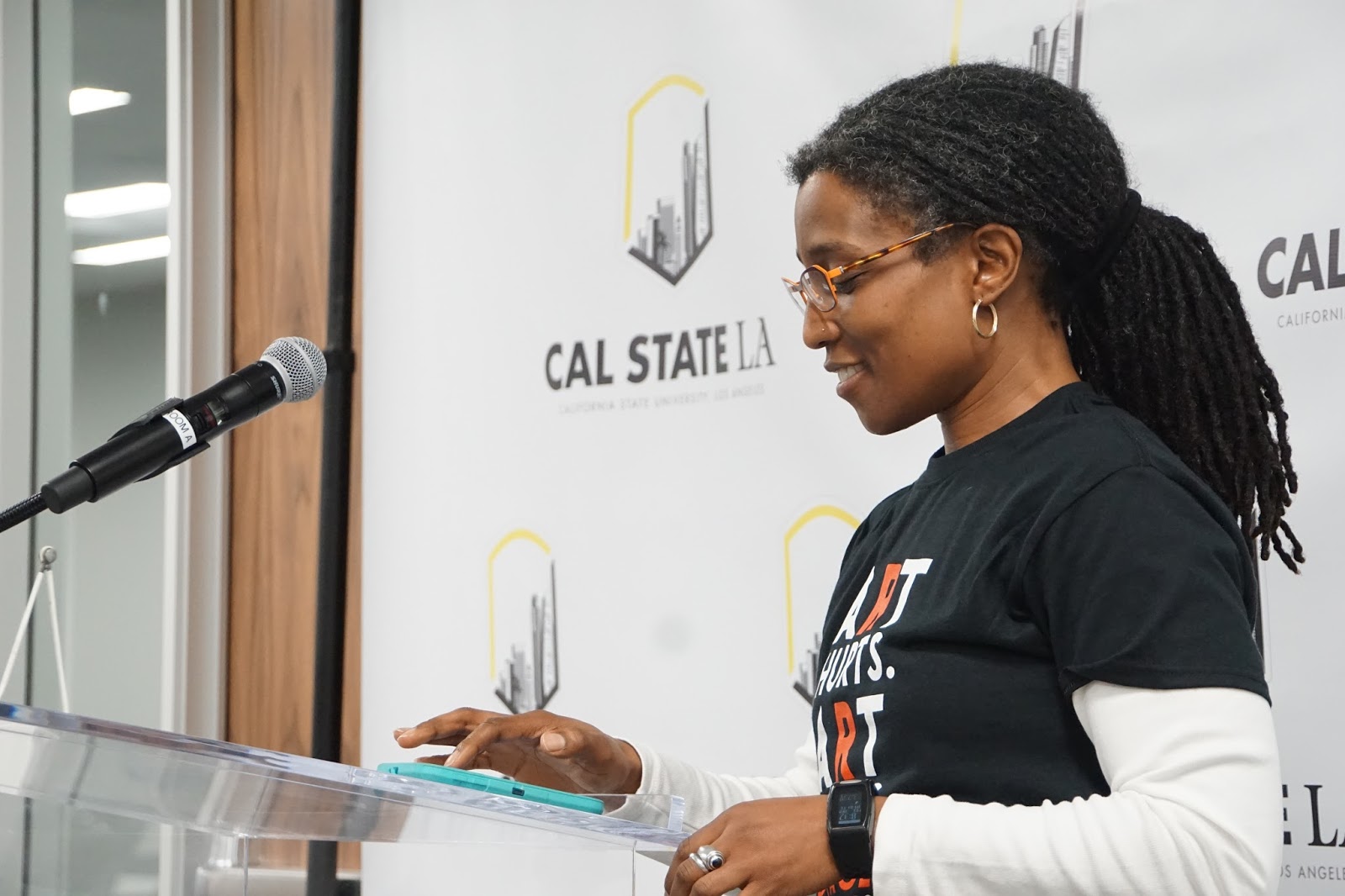
Last week in Los Angeles a band of angels gathered to lift up the language. Thanks to the organizing efforts of Lauri Ramey, her students, and the staff of Cal State Los Angeles, we were able to bring to the public the largest ever gathering of poets whose work appears in the anthology What I Say: Innovative Poetry by Black Writers in America, available from University of Alabama Press.
In one room, in one night, an enthusiastic audience of AWP conference goers and Los Angeles residents got to hear poetry from the book, and new works, from Dawn Lundy Martin, Harryette Mullen, Will Alexander, C.S. Giscombe, Duriel Harris, Harmony Holiday, Erica Hunt, Geoffrey Jacques, Douglas Kearney, Tracie Morris, Fred Moten, Julie Patton, giovanni singleton AND Ronaldo Wilson, nearly half the contributors to the volume.
We made a recording of the event, which will appear at some future date on Penn Sound so that this rare convergence can be recalled by all.
In the coming weeks there will be smaller readings around the country, including Pia Deas, Mark McMorris, T.J. Anderson, Tyrone Williams and others. More to come in the Fall.
[photo by Alex Espinoza]
Wednesday, March 16, 2016
RACE, ETHNICITY AND PUBLISHING IN AMERICA
I've been rereading this book that Manuel Brito was kind enough to send me as part of my preparation for the Early African Diasporic seminar at Penn State.
This volume has great chapters on early black historians, The Southern Negro and the Public Library, Hurston and stereotypes, Toomer and the Double Dealer, Phillis Wheatley "in Slavery's Recollective Economies" and much else. Manuel's own chapter is on "Widening the Paradigm of American Literature: Small Presses in the Publishing and Creation of New Hispanic Texts."
For more information click here.
Wednesday, March 02, 2016
E. Ethelbert Miller - The Aldon Nielsen Project #16 - "SAINT THOMAS OF LITERATURE"
Q. Provide us with a brief overview of the career of Lorenzo Thomas. What were his major contributions to American literature? When did you first encounter his work?
“All silence says music will follow”
Those words were my first encounter with Lorenzo Thomas. They form the opening line of “Onion Bucket,” one of two poems by Thomas selected by Larry Neal and Amiri Baraka for inclusion in Black Fire, at the time and still the major compendium of Black Arts Movement writings. The next Thomas poem in the anthology was “Twelve Gates.” I was a teen-aged reader at the time, still finding my way to the poetry that was to obsess me for life. These poems burnt themselves into my consciousness. I knew I would read more.
That “more” began coming my way a few years later, during my student years. I began to see copies of Hoo Doo review at a book store off Dupont Circle. There in issue number one was an offering by Thomas, “Sounds of Joy,” a title reminiscent for me of both Sun Ra and the joyful noise of the churchical. Hoo Doo 2 found Thomas weighing in with “Cosmic Communion.” The poem imagines a communication from a “magnetic magician” who advises “Be on a first name basis with planets / and stars.” Come the aptly identified issue 6 ½, and Thomas had signed on as guest co-editor with Adesanya Alakoye, who had been in an algebra class at Federal City College with me for a hot minute. Thomas’s own contribution to that issue was his essay on “Baraka in Newark.”
I still knew little of Lorenzo Thomas apart from these wonderful poems that appeared in some of the anthologies I was picking up, such as the encyclopedic The Poetry of Black America. and the stray prose piece in a journal here or there, and most of his early work was appearing in very small print runs from even smaller presses in New York, like Angel Hair press. It wasn’t until his collection The Bathers appeared in 1981 that I was able to see the full range of Thomas’s work, to see some of the magazine poems I’d encountered in the company of the poems from his small press books. “Onion Bucket,” “Twelve Gates,” “Cosmic Communion,” they were all here in this volume that Thomas had assembled, reproducing some of the art work by his brother, Cess, that had previously only been seen in those limited editions. The Bathers was itself limited, and is long out of print. (A couple decades ago I was able to teach the book in a class only because a forgotten box of the books had been found in a Berkeley basement and put on sale.) A bit later I found, in that same Dupont Circle shop where I’d run into Hoo Doo review, a book by Thomas that had in fact been published a couple years before The Bathers, Chances Are Few, from Blue Wind Press. The work in The Bathers had represented his major efforts from the beginning up to the mid-seventies, while Chances Are Few, despite preceding it, collected the then more recent work. (A new edition of Chances Are Few was published in 2003 with a few additional poems. That second publication remains available from Blue Wind.)
Slowly I began to learn more about this startlingly original poet. He had been one of the youngest members of the legendary Society of Umbra, a group of writers radical in both aesthetics and politics who had been congregating on New York’s lower East Side at readings that had themselves become the stuff of legend. Taking their name from a poem by one of the older members, Lloyd Addison, the group brought together both uptown and downtown poetic revolutionaries, and was later seen as having contributed to the emergence of the Black Arts Movement. Other writers participating included David Henderson, Oliver Pitcher, Norman Pritchard, Tom Dent, Art Berger, Maryanne Raphael, Askia Muhammed Toure, Calvin Hernton and so many more who were to be heard from significantly in the years to come. The group published several issues of an Umbra journal, which Henderson continued after he had moved to Berkeley. It was there that the famous Latin Soul issue of Umbra appeared. During my grad student years, I signed up for a class taught by Amiri Baraka, in the course of which I annoyed some of my fellow students (though evidently not Baraka) by using the discussion time to ask questions about Umbra, the Society of Young Men, poetry in the Village, etc. Lorenzo Thomas had been at the very heart of those activities, and as a scholar he was to become one of the most prominent historians of the group and their era, publishing important essays in places like the journal now known as African American Review. (Several scholars, including Jean-Philippe Marcoux, are digging into the archives and doing serious new work on Umbra – watch for their publications in the near future.)
But even as the Society of Umbra is gaining long overdue scholarly attention, Lorenzo Thomas’s years in Texas remain largely unattended. Recently I was talking to a colleague from another university who expressed surprise when I began talking of Harryette Mullen’s Texas years, of her interactions with Lorenzo Thomas and Ahmos zu Bolton – Not surprising when you notice things like the Kevin Young-edited anthology of poets born in 1960 and later, Giant Steps, which finds space for Harryette Mullen by changing her date of birth. Lorenzo Thomas played a crucial role in encouraging any number of important poets during the years after he left New York.
So by the time I finally got to know Lorenzo Thomas in person, I had come to a real appreciation of his importance as a poet, and as a participant/scholar of some crucial developments in the evolution of post-WWII poetry and poetics in this country. It was poet Charles Bernstein who made the introduction. As I remember it, we were standing in the lobby of a D.C. hotel during the convention of the Modern Language Association. Thomas was a gracious and generous person, with exactly my kind of wry humor, and we rapidly became fast friends. Over the coming years we were to appear on many stages together. We used to joke that we had become a sort of traveling tag team of poetry commentary; at one conference, he would give a keynote with me as respondent, and then at another it would be my turn to hold forth with Lorenzo coming on to set me straight. I recorded some of these sessions, and have been making a selection of them available from my archive at the Penn Sound web site. One of the more memorable occasions is one I only recently uploaded to Penn Sound. Lorenzo and I had been part of a wonderful gathering to honor Sterling Brown’s legacy at the Folger Shakespeare Library. Lorenzo and I were on a panel with Elizabeth Alexander. The event featured commentary by Haile Gerima, whose film After Winter remains the major documentary on Brown, my friend Joanne Gabbin, author of the first book-length study of Brown, Dolores Kendrick, Bernice Johnson Reagon, the whole thing moderated by Kojo Nnamdi. It was a powerful day and evening. Afterwards, Libbie Rifkin suggested that we do a smaller version as a panel at the AWP conference coming up in Baltimore. Lorenzo and I agreed at once.
Come the day, though, and Libbie was unable to join us, due to illness if I recollect, so Lorenzo and I were on our own. AND the conference organizers had stuck the thing in one of the 8:30 AM time slots. Lorenzo and I headed into the hotel basement wondering if anybody would be up and in attendance. When we arrived, there was Lucille Clifton already in a seat and ready for the session to get going. Lucille, another old friend from my grad school days, had been one of Brown’s students at Howard, and there was no way she was going to miss this. You can hear what Lorenzo and I said that day by navigating to this URL:
https://media.sas.upenn.edu/pennsound/groups/Heatstrings/Thomas-Lorenzo-and-Nielsen-Aldon_Sterling-Brown-Panel_AWP_Baltimore_3-1-03.mp3
Over time, Lorenzo and his partner, Karen Luik, would meet socially with me and Anna. Sometimes we’d be with others, like the time when we were all in Houston to honor Lorenzo’s work at the American Studies Association. (Lorenzo insisted on taking us all to dinner afterwards – Maria Damon and Kalamu ya Salaam were with us, I remember.) Other times it would be just the four of us. More than one year, we conspired to be at Boulder at the same time, along with Harryette Mullen at least once, and after doing various things for Naropa we’d spread a blanket behind their building and enjoy the fireworks together.
There was a long dry spell for Lorenzo, not in writing, but in book publishing. But then things started happening fast. There was a 1996 bilingual English/German collection from Edition Isele, There Are Witnesses / Es gipt Zeugen. In 1998, the Teachers and Writers collaborative published a volume by Lorenzo on African American literature in the creative writing class. In 2000, the University of Alabama Press published Lorenzo’s Extraordinary Measures: Afrocentric Modernism and 20th Century American Poetry in their prestigious Modern and Contemporary Poetics series. Then came the delightful chapbook Time Step: 5 poems 4 seasons, from a small press in California. That chapbook bore an epigraph from actor Donald O’Connor that aptly summed up Lorenzo’s career: “If you keep doing the Time Step long enough, people applaud.” Applause had been way too long coming to Lorenzo Thomas, but it was coming at long last. That chap book, like his early poetry collections, had been published in a limited print run, only one hundred copies, but much of the work became more widely available shortly thereafter in a triumphant volume from Coffee House Press, Dancing on Main Street. That book’s subsections bore titles that accurately reflected Lorenzo’s aesthetics: “Anyplace You’ve Ever Been,” “Rituals and Improvisations,” “The Simplest of All Mysteries,” “Resistance as Memory” and finally, “Dangerous Doubts.” We were back, it would seem, at sounds of joy and cosmic communion. No less than John Ashbery said that “Thomas’s brand of clairvoyance is not only useful, but beautiful.”
But Lorenzo didn’t have long to enjoy this late applause. He’d had health problems for a while. There’d been some pretty serious oral surgery that had affected his speech (though not his enthusiasm). Then the effects of his earlier smoking took their full toll. Lorenzo had to cancel a few out of town gigs; he was linked to oxygen now, and was just getting used to what that meant for his getting around. Still, the poetry continued coming, and there was the manuscript of another prose book going through the process of the University of Michigan Press. Then I got the message none of us is ever prepared to receive. Lorenzo sent me an email asking that I serve along with his brother as his literary executor. I emailed back to tell Lorenzo that while I would be honored to accept that heavy responsibility, he’d probably be doing the job for me long before I’d have to do it for him. (Not an extravagant reassurance – I’d survived octuple bypass surgery, so had a sort of expiration date of my own.) Only two weeks later, I got the devastating news from Karen that Lorenzo had passed from us.
These things hurt, but the work waiting to be done eased the pain a bit. I got busy doing the final editing on Lorenzo’s prose volume that he hadn’t lived to do, and in 2008, Michigan published Lorenzo’s Don’t Deny My Name: Words and Music and the Black Intellectual Tradition, a book so solid and so encompassing that the good folks at the University of Kansas History of Black Writing Project organized two NEH summer institutes thematically based in Lorenzo’s book. Next project on the horizon: The Collected Poems of Lorenzo Thomas.
I’ve never forgotten that first long ago reading in Lorenzo’s lines:
And those who own nothing what of those walking around
Without land, without cash value, properties. Without
Nothing in the name. Whose destinies
Are not marked or marked down.
When he signed my copy of the book that includes that poem, Lorenzo wrote words for all of us to live by: “All this effort / is toward / a better world.”
Thursday, February 25, 2016
THEORIZING BLACK LITERATURE NOW -- RUTGERS 2016
Evie Shockley and Carter Mathes pulled together a remarkable congress of thinkers and writers a couple weeks ago for a two day discussion exploring current and future directions in African American literary criticism. We met in the Plangere Writing Center at Rutgers University, the wind whipping the streets outside (about the coldest I've experienced in recent years) and driving us into the warmth of our conferring. Urban tumbleweeds we were, our spirits blown up mighty mighty.
I came eagerly looking forward to discussions with the people listed in the program; when I got there I found poets Tonya Foster, Ron Silliman and Erica Hunt in the house, and scholars Kathryne Gines, Cheryl Wall and Mary Helen Washington, along with so many others who had braved the weather to join together.
I was on the first panel, "The Nation and State in African American Literature," with Miriam Thaggert and Erica Edwards, Tasia Milton responding. My presentation was another installment from the work I've been doing this year on temporality, race and nation, As usual with me, I was operating from a floating home base in music and verse. I didn't get any panel selfies; maybe someone in the audience has a photo of us. But I did collect a good audio recording of the session.
Other sessions took up "Defining Blackness" and "Metacritical Directions." Brent Hayes Edwards offered a keynote with further meditations on the archive.
At the close, Mathes and Shockley, who had been writing constantly in those little notebooks of theirs, drew forth a set of discussion questions and, like the title says, future directions. Then it was off to dinner, where we continued our round table at one long, narrow table.
Subscribe to:
Posts (Atom)