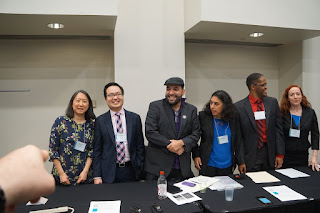
[At this year's MLA in Austin, I participated in a round table with these critics and poets you see me pointing out here. We each made opening statements, and then had an engaging discussion with the standing room only crowd in the room. Below is the text of my opening.]
5" 20"
I want one ethnic thing here
right from the start. Dis-
orientation.
–Fred Wah
As we began to conclude our preface to an anthology of innovative writings by black artists in America, Lauri Ramey and I wrote that the collection “may have the effect of putting a final nail in the coffin of the long-standing argument that black poets in America were busy ‘telling their own stories’ while white poets pursued a more experimental course.” The auxiliary function is important here. Experience, as well as our culture’s on-going fascination with zombies and vampires, teaches us that coffins are never sealed with any real finality; nails are all too often wrenched loose and the dead walk, and write, among us. A part of our frustration was that the argument we hoped to see buried at long last had, for generations, occluded behind multiple veils the thriving body of innovative literary arts created by putatively minority poets.
We hadn’t long to wait to see our frustrations reanimated.
A great puzzle of our critical moment is the quickness with which we seem to have forgotten lessons supposedly learned in our theory-laden recent past. Didn’t we all learn at last the lesson of the Celestial Emporium of Benevolent Knowledge, from Foucault if not from Borges? A system of logic that opposes “those that are included in this classification” to “those that tremble as if they were mad” is not a mode of thought likely to prove either productive or liberating. Leaving behind a time when all binary oppositions were to be deconstructed, we came to a time when we seemed to have forgotten what it was to analyse a binary opposition.
And so, for example, we have the recent spectacle of Helen Vendler, in her complaint against Rita Dove’s Penguin Anthology of Twentieth-Century American Poetry, opposing “multiculturalism” to aesthetic value, as if there were a definable distinction between these two categories. Similarly, an invidious distinction between “identity politics” and “experimental writing” has, over this past year, been at the heart of arguments in American poetry as if we had all agreed on the meaning of these terms, as if they were mutually exclusive categories, as if the body of work left us by Amiri Baraka or Jayne Cortez had never been read.
And it is just that mode of catachresis that animates, for one instance, Aaron Kunin’s desire, in a response to the Vanessa Place controversy, to oppose the categories of racism and bad writing. This desire leads him eventually to the worst sort of straw man argument. Characterizing the complaints about Place’s Gone with the Wind Project, Kunin writes:
"The idea behind this accusation seems to be that any writing that uses racist language or imagery is itself racist, and, if the writer is white, white supremacist. By that logic, any representation of racism would be racist. The study of racism would become impossible. At best, the study of racism could proceed only by further inflicting or exploiting the pain of what it studies."
As someone who has been studying racism for most of my life, I’d be among the first to admit that it is impossible to study racism without feeling and perhaps inflicting pain. But by this logic, something like Alice Randall’s Wind Done Gone would be labeled a racist exercise despite the blackness of its author, and Richard Powers’ magnificent novel The Time of Our Singing, or Armand Schwerner’s poem written as a memorial to Micheal Schwernber, murdered by racists in Mississippi, a poem read at a rally for the then imprisoned Amiri Baraka, would themselves be labeled instances of white supremacy.
Just as the opposition of identity to experimentation can have the effect of erasing the history of poets identified in one sense or another as “minorities,” this form of illogic simultaneously erases realities of racism while heaving open the gates for the continuation of racial politics as usual. Tony Hoagland is not an “experimental” poet in any usual sense. He has written that:
"White writers, for their part, are caught in the double–or triple–bind of power, apology and hatred. As a result, they feel mostly compelled to say nothing, at least nothing remotely controversial, on the subject of race." (201)
And even though Hoagland here presumes to speak for all white writers, clearly the self-censorship he describes has, regrettably in this instance, never applied to him. In a similar vein, Martha Collins, deploying a yet more encompassing royal “we,” declares that we are all racist (157), a judgement that has the real effect or erasing racism itself.
I am under no illusions, even given that hope expressed in the preface to the collection What I Say. There are racists in the world of experimental writing, and always have been. This is not a property of experimentalism any more than it is inherent in the structures of mainstream verse, despite the examples of Tony Hoagland, Ellen Bryant Voight, Dave Smith and so many others. Race was itself an experiment of sorts. And while it would be immoral, after the fashion of Chief Justice Roberts, to demand of minority poets that they grace the white world with their specifiable diversity, it is unethical to allow racialist modes of critical thought to divide us from our experimental selves, to deliver us once more to banalities and blindness.