IN WHICH WILL BE FOUND WHAT IS SET FORTH THEREIN

Friday, January 14, 2011

MLA 2011 - Part I


Michael Davidson got this year's Modern Language Association convention started with a panel he'd organized for the Poetry Division in collaboration with the Division on Disability Studies. The scholars speaking on the topic of disability poetics at this roundtable included Petra Koopers, Jessica Lewis Luck, Janet Lyon, Heidi Rose and Susan Schweik. I believe this marked the first time I'd heard a discussion of the poetry of C.S. Giscombe at an MLA panel -- Hope to see more of that in the future.


There was a worthwhile pairing of panels later that day from the Division on Black American Literature and Culture on African American Studies in the Postrace Era and the question "Is There a Crisis in Black Research Publishing?" Many of us went to both, and so the discussion we started with the first panelists carried over to the next session, and on through the weekend.Spellman's Donna Akiba Sullivan Harper, who'd made an intriguing presentation from the point of view of HBCU students during that first session, was seen snapping photos, so I hope she'll upload hers somewhere soon.


The Film Division hosted another roundtable, on transmedia activism. Sure wish I could get the new media poetics people and the transmedia people into the same room some time so they could all hear each other.


Sad to say (but glad to hear her) Dana Williams is still the only person doing solid work on novelist Leon Forrest at the MLA. Come to think of it, a Chicago MLA was the scene of my meeting Forrest when Jerry Ward introduced us at lunch as the convention was wrapping up.


We were all feeling a bit surreal meeting at the MLA in January, so it seemed only fitting to go to Jonathan Eburne's session of the Association for the Study of Dada and Surrealism.

My watch melted halfway through.

Monday, January 10, 2011

POETS AT MLA 2011


Afaa Michael Weaver
Meta Jones


Kit Robinson


Much more to come when I get back to campus . . . .


Thursday, December 30, 2010

INSIDE SONGS OF CURTIS MAYFIELD


Among the highlights of my international music trading in recent years has been a set of concerts from Europe in which William Parker and company performed the bassist/composer's stunning work "The Inside Songs of Curtis Mayfield."


In my D.C. days, Jerry Washington, host of WPFW'S THE BAMA HOUR, used to have a recurring segment of his show called the "inner message in the music," a segment in which

listeners were challenged to identify the links joining the several, some times disparate, selections Jerry played.Parker has been up to something a bit different.


Musicians often talk about trying to get inside a piece, and it has long been clear to me that musicians who played outside were often those best suited to find that interiority. William Parker writes that "every song written or improvised has an inside song which lives in the shadows, in-between the sounds and silences and behind the words, pulsating, waiting to be reborn as a new song."

That's an apt description for what we hear in these concerts exploring the music of Curtis Mayfield. It reminds me of Aretha's brilliant reworkings of the songs Mayfield contributed to the sound track of the movie Sparkle. Vocalist Leena Conquest does much the same within Parker's recompositions of the Mayfield catalogue.

Further, Amiri Baraka (who previously released a collection of recordings titled New Song) finds new words in the corners of the lyrics Mayfield wrote and Conquest sings.

Until recently, few in the U.S. had heard any of this. Now, though, a two disk compilation of the concerts has been released on the AUM FIDELITY label. Individual tracks are drawn from concerts in Italy, France and the United States, and joining Parker's group (which includes Hamid Drake and Dave Burrell ) is the New Life Tabernacle Generation of Praise Choir. Curtis Mayfield, author of "We the People Who Are Darker than Blue," was always a poet, as much on the guitar as in his lyrics, and the mashup between him and Baraka is not to be missed.

Now that these concerts are available to the general public, I can only hope that they will find the audience they so deserve. This is one of the finest workings of jazz and poetry you will hear.


"I Plan to Stay a Believer." A good resolve for 2011.

Thursday, December 16, 2010

CROSS CULTURAL POETICS No. 23

Just in time for the holidays, here comes a stocking stuffer from Cross Cultural Poetics, XCP No. 23.

Here you'll find a new essay by Tyrone Williams on New Criticism and the Civil Rights Movement, poems by Adrienne Rich and Mahmoud Darwish, more work on war resistance poetry by Phil Metres, Timothy Yu writing on John Yau and Bill Barrette, a great poetry review from Maria Damon wherein the review is as compelling as the poetry she's reading.

My own contributions are "Sit-in at Bulworth's," a short meditation on racial definition and power, and a book review of A New Notion: Two Works by C.L.R. James.

You can find subscription information for XCP here, and check out the XCP blog site over here.

Monday, December 06, 2010

click to hear CHARLES BERNSTEIN @ PENN STATE


and here is one of the reasons I work at a place like Penn State -- just a half hour after that reading, and a short walk away, there was another reading by Charles Bernstein. The photo here at the top is not from the reading, but from Bernstein's segment of the Sean Connery film Finding Forrester, in which Charles plays the role of a school principal. He looks in this photo very much to be playing the same role he brought off to great effect in his Yellow Pages commercial, which he replayed for us the next day at the beginning of his talk.


The talk drew primarily from Bernstein's forthcoming book, Attack of the Difficult Poems, available for preorder from University of Chicago Press here.


Thanks again to Jeff Nealon for organizing Bernstein's visit. I've been reading the poems and essays of Charles Bernstein for more than three decades now, and wrote an early review of Controlling Interests for the D.C. mag Gargoyle during my student days. "So really not visit a remember to strange" he wrote in that book, no doubt foreseeing his 2010 touchdown in Happy Valley.

TOI DERRICOTTE AT PENN STATE

Poet Toi Derricotte was on campus last week for a day of workshops and a reading, organized by several of my dear colleagues. The reading kicked off with introductions by Shirley Moody-Turner (who had driven over from her postdoc at Rutgers just for the occasion) and Robin Becker.


One of the poems Toi read was this piece about the El Mina slave fortress, which I had visited on my trip to Ghana:

The Tour
The castle, always on an
outcrop of indifference;
human shells,
the discards on the way.
Where our mothers were held, we walk now
as tourists, looking for cokes, film, the bathroom.
A few steps beyond the brutalization, we
stand in the sun:
This area for tourists only.
Our very presence an ironic
point of interest to our guide.


[This is the "gate of no return" at El Mina.]


Saturday, December 04, 2010

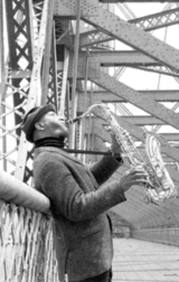
THE RETIRING OF SONNY ROLLINS


[A POEM I WROTE IN THE ANCIENT OF DAYS BUT HAVE NEVER INCLUDED IN A BOOK]


Sonny mounts the bridge and drives
The suicides beneath his keys to blow
The one sympathetic note that strikes the span senseless
Not retired but assumed into
The cable stitched heavens above
Neither sky nor sea
Flung out between radio snatching rails
To share that same ethereal gleam
Its antennaed supports plucking
Ambient overcast below
Prince over the powers of the air
Sonny sends
His winded tune skipping along arcs
Massively repeating the belled curve to
Towering horns seizing ships
Sonny sounds the altitudes
Where breath upholds the bridge
There he is tempted there reconciled
Concentrating within the exhaled pause sighs
Lapping darkly at piles recalling
Sonny to his drifting continent
Pads beneath his fingers fall
Upon that instrument that points to both
Here and there grounded waves
Roll in as Rollins
Descends Rollins
Resumes


Monday, November 29, 2010

CHARLES OLSON AT THE HARBOR

Ralph Maud's vital recent book Charles Olson at the Harbor (available here) is billed on its cover as "A Biography." The book's truer nature comes clear in Maud's Introduction, where he describes it as a "reactive biography" and expresses the hope that this volume might "stand as the full-length biography that [he] once intended to write." The book is in fact a full-length correction to Tom Clark's earlier Charles Olson: The Allegory of a Poet's Life. I always appreciated the grammatical ambiguity of Clark's title, preferring to read it as an allegory in the place of a biography, hoping that a more reliable life would soon appear in print. You could almost construct that better bio by reading Clark's book with Maud's later volume in hand, and that may be the best we can do for some time. Clark was much in need of correction, and while Maud may on occasion stretch a point a bit far (it is probably not accurate to describe Olson as "the first literary figure to use the term" postmodern, for one instance), in sum his is the more accurate rendering, something you'd think important for the life of a scholar poet.

It is a humbling realization for all of us scholars that our own correctives are instantly themselves in need of correction, and I'm sure Maud will forgive my startled amusement as I read the following:

"In Miscellaneous file #147 at Storrs there is the following note to Flossie Williams, wife of William Carlos Williams and, in March of 1936, newly a widow."

Rumors of Williams's death in 1936 are, of course, severely premature.

But typos aside, Maud has done a great service to Olson's legacy and to the scholarship of American poetry more generally. (And the photos are great fun, too.)

A valuable addition to the Olson files.

Thursday, November 18, 2010

Brathwaite's elegguas

New from Wesleyan University Press is this latest volume of poetry by Kamau Brathwaite.

The book is structured around letters to his late wife which first appeared in different form in the book The Zea Mexican Diary (published by Wisconsin in '93). Those letters begin and end the new book, and there is one about a third of the way into the text. This is a fitting structure for a book of elegies that also summons the Yoruba Eleggua, generally encountered in doorways and at crossroads.

The poems are presented in Brathwaite's Sycorax video text and all the usual wordplay is on display. So, for example:

Let me hear it one more time
for
IVIE
ANDERSONNNG

&

DC
in summer
hot almost too simmer to sip. sop sit out on the stoep
with old men. cymbell children

cries rising like these northern egrets
above the railway tracks
where Sonny Greer come walk
ing down the sidewalk clickin sticks

.

Tuesday, November 09, 2010

NEW WORK FROM MANUEL BRITO

The legendary Manuel Brito, publisher of Zasterle Editions in Tenerife, has recently published Means Matter, the product of his many years of careful reading and his research trips to the United States. His critical examination of publishing and circulating practices among innovative poetry communities makes extensive use of manuscript materials and so will reward even readers who are intimately familiar with the published record. For more information on this book, click here.

Wednesday, November 03, 2010

WE FREE KIN


Some time ago I heard from Catherine A. Lee, a poet I had not known of before, who, as it turns out, had been close to Percy Johnston and other artists I've been researching over the years. While I still have not met Catherine, I am grateful for her generosity. She has shared a number of important Johnston-related materials which have much added to my understanding of his life and work.

And then she sent me this beautiful . . . well, what to call it. It's sort of a chapbook, sort of an accordion artist's book. Not to say a book by an accordionist, but a booklet that unfolds and refolds, making its own kind of verbal music. Catherine, after many years in the Boston area, is now in San Antonio. Keep an eye out for her performances.

Monday, November 01, 2010

Don't Forget to buy AMNESIAC

This is just to say, the incomparable Duriel Harris has published a new book of unforgettable poems.

Monday, October 18, 2010

Circulating in Le Mans


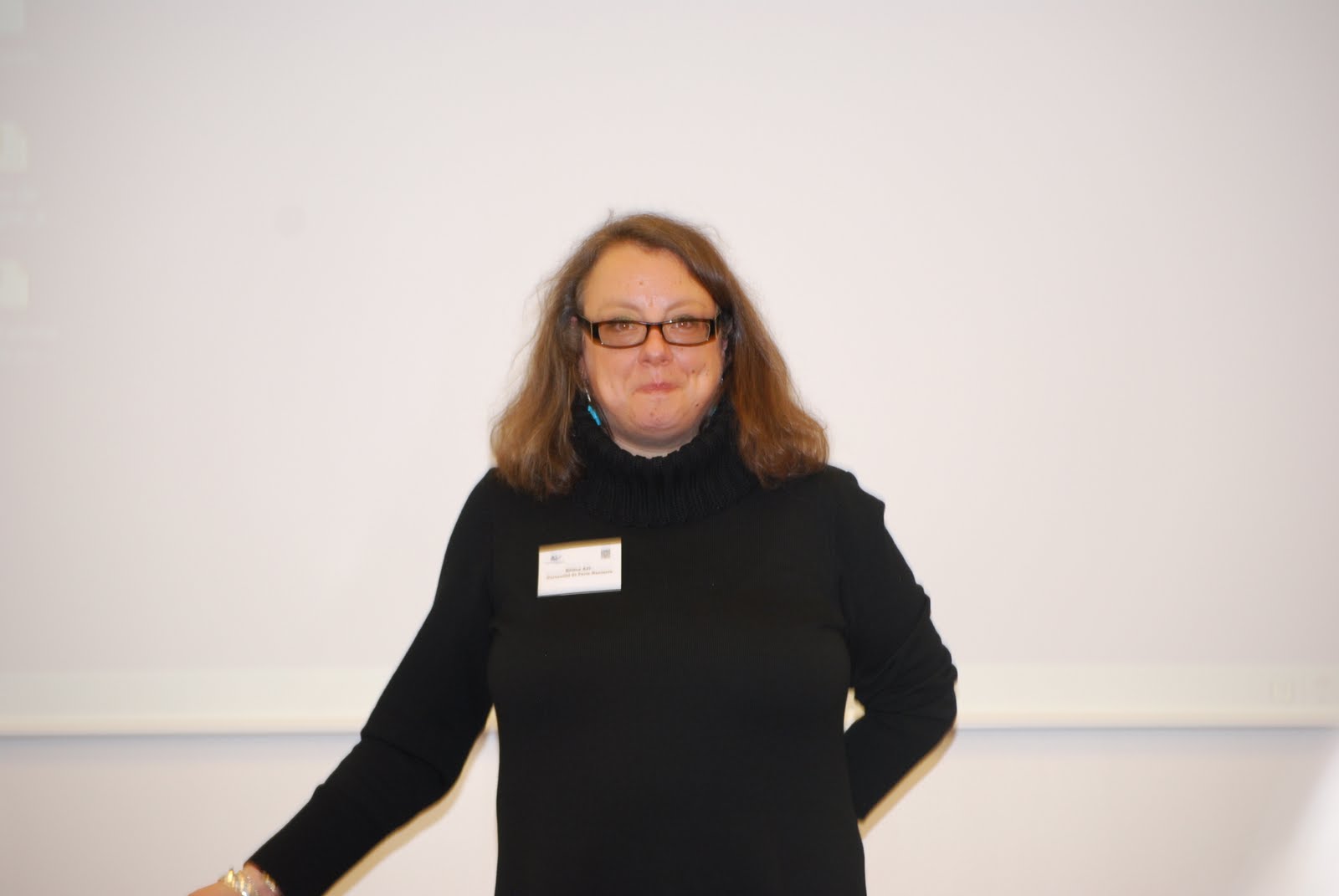
El Blogeador is taking advantage of the free access to the Orange Network in the Paris airport Novotel Hotel to upload these photos from the just completed international conference, "Poets and Publishers: Circulating Avant-Garde Poetry (1945-2010)."

It seemed only fitting that a conference on avant-garde circulation should be beset by strikes interrupting circulation throughout France. We all stayed in good humor, though, and the majority of us managed to find a way to get to Le Mans and the Universite du Maine (why is it that universities with "Maine" in their name are so friendly to poetry?), where Helene Aji and Manuel Brito, along with their able colleagues, had organized days of avant exchange among poets and critics. We were from Spain, France, the USA, Canada, Italy -- and we were all there to talk about the news that stayed. There were papers on Scottish small press publications, on visual poetics, on artists' books, on post-Umbra African American poetry, even on Robert Duncan's typewriters.


And there were poetry readings by Jacques Darras and Jerome Rothenberg.


On the second day, strikers stopped the tram cars in their tracks in Le Mans, but that didn't stop our poetry. Most of us support the position of the strikers anyway, so just lengthened our stride a bit and visited with the workers and students in the streets.

My own Paris trains were removed from the schedule, but that just meant that I got to see the Cathedral of Chartres out the window of the much slower train that eventually got me to the conference, as I will eventually get back home. The welcoming students I met at the university and on those trains that ran did much for my own circulation.

Salud